On this page
Lyrics with meaning
The complete Santoshi Mata Chalisa – two opening dohas, forty chaupais, and a closing doha. A short English meaning sits below every verse. Toggle the script to read in Devanagari, romanized, or both side-by-side.
श्री गणपति पद नाय सिर, धरि हिय शारदा ध्यान। सन्तोषी माँ की करूँ, कीरति सकल बखान॥
Shri Ganpati pad naay sir, dhari hiy Sharada dhyan. Santoshi maa ki karun, kirat sakal bakhan.
Bowing my head at the feet of Shri Ganpati, holding Saraswati in my heart in meditation. I now sing the entire glory of Mother Santoshi.
जय संतोषी माँ जग जननी। खल मति दुष्ट दैत्य दल हननी॥
Jai Santoshi maa jag-janani. Khal mati dusht daitya dal hanani.
Hail Mother Santoshi, mother of the world. Slayer of the wicked-minded, evil hosts of demons.
गणपति देव तुम्हारे ताता। रिद्धि सिद्धि कहलावहं माता॥
Ganpati dev tumhare tata. Riddhi Siddhi kahlavahain mata.
Lord Ganpati is your father. Riddhi and Siddhi are called your mothers.
माता-पिता की रहौ दुलारी। कीरति केहि विधि कहूँ तुम्हारी॥
Mata-pita ki rahau dulari. Kirat kehi vidhi kahun tumhari.
You are the beloved of your mother and father. How can I describe your glory adequately?
क्रीट मुकुट सिर अनुपम भारी। कानन कुण्डल की छवि न्यारी॥
Krit mukut sir anupam bhari. Kanan kundal ki chhavi nyari.
On your head, an unmatched crown of beauty. The earrings on your ears have an extraordinary glow.
सोहत अंग छटा छवि प्यारी। सुन्दर चीर सुनहरी धारी॥
Sohat ang chhata chhavi pyari. Sundar cheer sunhari dhari.
Your form shines with beautiful radiance. You wear a beautiful golden saree.
आप चतुर्भुज सुघड़ विशाला। धारण करहु गले वन माला॥
Aap chaturbhuj sughad vishala. Dharan karahu gale van-mala.
You are four-armed, finely formed, and majestic. You wear the forest garland (vanmala) around your neck.
निकट है गौ अमित दुलारी। करहु मयूर आप असवारी॥
Nikat hai gau amit dulari. Karahu mayur aap aswari.
The much-beloved cow stands near you. You ride upon the peacock.
जानत सबही आप प्रभुताई। सुर नर मुनि सब करहिं बड़ाई॥
Janat sabhi aap prabhutai. Sur nar muni sab karahin badai.
Everyone knows your sovereignty. Gods, men, and sages all sing your praise.
तुम्हरे दरश करत क्षण माई। दुख दरिद्र सब जाय नसाई॥
Tumhare darash karat kshan mai. Dukh daridra sab jaay nasai.
The very moment one takes your darshan, Mother. All sorrow and poverty are destroyed.
वेद पुराण रहे यश गाई। करहु भक्त की आप सहाई॥
Ved Puran rahe yash gai. Karahu bhakt ki aap sahai.
The Vedas and Puranas continue to sing your fame. You are the helper of every devotee.
ब्रह्मा ढिंग सरस्वती कहाई। लक्ष्मी रूप विष्णु ढिंग आई॥
Brahma dhing Saraswati kahai. Lakshmi roop Vishnu dhing aai.
You are called Saraswati near Brahma. As Lakshmi you reside near Vishnu.
शिव लिंग गिरजा रूप बिराजी। महिमा तीनों लोक में गाजी॥
Shiv ling Girija roop biraji. Mahima teenon lok mein gaji.
Near the Shivling you are seated as Girija (Parvati). Your glory thunders through all three worlds.
शक्ति रूप प्रगट जन जानी। रुद्र रूप भई मात भवानी॥
Shakti roop pragat jan jani. Rudra roop bhai mat Bhavani.
You manifest as Shakti, knowing each devotee. As Rudra-form you are Mother Bhavani.
दुष्ट दलन हित प्रगट काली। जगमग ज्योति प्रचंड निराली॥
Dusht dalan hit pragat Kali. Jagmag jyoti prachand nirali.
To slay the wicked, you appeared as Kali. With dazzling, fierce, extraordinary radiance.
चण्ड मुण्ड महिषासुर मारे। शुम्भ निशुम्भ असुर हनि डारे॥
Chand Mund Mahishasur mare. Shumbh Nishumbh asur hani dare.
You slew Chanda, Munda, and Mahishasura. You destroyed the demons Shumbha and Nishumbha.
महिमा वेद पुरानन बरनी। निज भक्तन के संकट हरनी॥
Mahima Ved Puranan barni. Nij bhaktan ke sankat harni.
Your glory is described in the Vedas and Puranas. You lift away the troubles of your own devotees.
रूप शारदा हंस मोहिनी। निरंकार साकार दाहिनी॥
Roop Sharada hans mohini. Nirankar sakar dahini.
As Saraswati, riding the captivating swan. You are formless and form-bearing both, righteous one.
प्रगटाई चहुँदिश निज माया। कण कण में है तेज समाया॥
Pragatai chahundish nij maya. Kan kan mein hai tej samaya.
You have manifested your maya in all directions. Your radiance pervades every atom.
पृथ्वी सूर्य चन्द्र अरु तारे। तव इंगित क्रम बद्ध हैं सारे॥
Prithvi Surya Chandra aru tare. Tav ingit kram baddh hain sare.
Earth, the sun, the moon, and the stars. All move in their orbits at your gesture.
पालन पोषण तुम्हीं करता। क्षण भंगुर में प्राण हरता॥
Palan poshan tumhin karta. Kshan bhangur mein praan harta.
You alone nurture and sustain. And in a fragile moment you take away life as well.
ब्रह्मा जी विष्णु तुम्हें निज ध्यावै। शेष महेश सदा मन लावें॥
Brahma ji Vishnu tumhen nij dhyavai. Shesh Mahesh sada man lavein.
Brahma and Vishnu meditate upon you. Sheshnaag and Shiva keep you constantly in mind.
मनोकामना पूरण करनी। पाप काटनी भव भय तरनी॥
Manokamna puran karni. Paap katni bhav-bhay tarni.
Fulfiller of every heartfelt wish. Cutter of sin, ferry across the fear of worldly existence.
चित्त लगाय तुम्हें जो ध्याता। सो नर सुख सम्पत्ति है पाता॥
Chitt lagaay tumhen jo dhyata. So nar sukh sampatti hai pata.
Whoever meditates on you with focused mind. That person receives happiness and prosperity.
बन्ध्या नारि तुमहिं जो ध्यावै। पुत्र पुष्प लता सम वह पावैं॥
Bandhya nari tumahin jo dhyavai. Putra pushp lata sam vah pavain.
A childless woman who meditates on you. Receives a child like a flower upon a vine. (A verse of devotional faith, not a replacement for medical care.)
पति वियोगी अति व्याकुल नारी। तव वियोग अति व्याकुल यारी॥
Pati viyogi ati vyakul nari. Tav viyog ati vyakul yari.
A woman separated from her husband, terribly distressed. From your absence, terribly restless, friend.
कन्या जो कोई तुमको ध्यावै। अपना मन वांछित वर पावै॥
Kanya jo koi tumko dhyavai. Apna man-vanchhit var pavai.
Any unmarried girl who meditates on you. Receives the husband her heart desires.
शीलवान गुणवान हो मैया। अपने जन की नाव खिवैया॥
Shilwan gunwan ho maiya. Apne jan ki naav khivaiya.
You are virtuous and full of all qualities, Mother. The boatwoman of your own devotees.
विधि पूर्वक व्रत जो कोई करहीं। ताहि अमित सुख सम्पत्ति भरहीं॥
Vidhi purvak vrat jo koi karahin. Tahi amit sukh sampatti bharahin.
Whoever keeps the vrat with proper procedure. Is filled with infinite happiness and prosperity.
गुड़ और चना भोग तोहि भावै। सेवा करै सो आनन्द पावै॥
Gud aur chana bhog tohi bhavai. Seva karai so anand pavai.
Jaggery and roasted gram are the bhog you love. Whoever serves you with these receives joy. (The signature offering of the Santoshi Mata vrat.)
श्रद्धा युक्त ध्यान जो धरहीं। सो नर निश्चय भव सों तरहीं॥
Shraddha yukt dhyan jo dharahin. So nar nishchay bhav son tarahin.
Whoever holds you in meditation with full faith. That person will surely cross the worldly ocean.
उद्यापन जो करहि तुम्हारा। ताको सहज करहु निस्तारा॥
Udyapan jo karahi tumhara. Tako sahaj karahu nistara.
Whoever performs your udyapan ceremony (the closing rite of the 16-Friday vrat). You make their liberation easy.
नारी सुहागिन व्रत जो करती। सुख सम्पत्ति सों गोदी भरती॥
Nari suhagin vrat jo karti. Sukh sampatti son godi bharti.
A married woman who keeps the vrat. Has her lap filled with happiness and wealth.
जो सुमिरत जैसी मन भावा। सो नर वैसो ही फल पावा॥
Jo sumirat jaisi man bhava. So nar vaiso hi phal pava.
Whoever remembers you as their heart wishes. Receives that very fruit.
सात शुक्र जो व्रत मन धारे। ताके पूर्ण मनोरथ सारे॥
Saat Shukra jo vrat man dhare. Take puran manorath sare.
Whoever keeps the vrat for seven Fridays with focused mind. All their heart's wishes are fulfilled.
सेवा करहिं भक्ति युत जोई। ताको दूर दरिद्र दुख होई॥
Seva karahin bhakti yut joi. Tako door daridra dukh hoi.
Whoever serves you with devotion. Their poverty and sorrow are removed.
जो जन शरण माता तेरी आवै। ताके क्षण में काज बनावै॥
Jo jan sharan mata teri aavai. Take kshan mein kaaj banavai.
Whoever takes refuge at your feet, Mother. Their work is accomplished in a moment.
जय जय जय अम्बे कल्याणी। कृपा करो मोरी महारानी॥
Jai jai jai Ambe kalyani. Kripa karo mori maharani.
Hail, hail, hail Amba, bringer of welfare. Show grace, my great queen.
जो कोई पढ़े मात चालीसा। तापे करहिं कृपा जगदीशा॥
Jo koi padhe maat Chalisa. Taape karahin kripa Jagdisha.
Whoever reads this Mother Chalisa. The Lord of the world (Jagdisha) showers grace upon them.
निज प्रति पाठ करै इक बारा। सो नर रहै तुम्हारा प्यारा॥
Nij prati paath karai ik bara. So nar rahai tumhara pyara.
Whoever recites the paath at least once. That person remains your beloved.
नाम लेत ब्याधा सब भागे। रोग दोष कबहूँ नहीं लागे॥
Naam let byadha sab bhage. Rog dosh kabahun nahin lage.
Taking your name, all afflictions flee. Disease and fault never touch them. (A verse of devotional faith, not a replacement for medical care.)
सन्तोषी माँ के सदा बन्दहुँ पग निशवास। पूर्ण मनोरथ हों सकल मात हरौ भव त्रास॥
Santoshi maa ke sada bandahun pag nishvas. Puran manorath hon sakal mat harau bhav-tras.
Always with each breath I bow at the feet of Mother Santoshi. May all heartfelt wishes be fulfilled, Mother, lift away the fear of worldly existence.
Why this chalisa
What the Santoshi Mata Chalisa is recited for, and what people turn to it for.
Anchor for the 16-Friday Shukravar Vrat
The most-known Santoshi practice in north India is the Solah Shukravar Vrat – sixteen consecutive Fridays of fasting, with the Chalisa as the morning recitation, the offering of gud-chana (jaggery and roasted gram) as bhog, and a final udyapan ceremony on the seventeenth Friday. The vow is widely kept by married women for the long life and well-being of their husbands, by mothers for their children's prosperity, and by individuals for any specific wish. Verses 28-31 directly describe the vrat's structure and merits.
For matters of marriage, family, and household harmony
Verses 24-26 name three classical situations the Chalisa addresses: a childless woman, a woman separated from her husband, and an unmarried girl seeking a husband. Many devotees recite the Chalisa daily through stretches of marriage difficulty, family conflict, or fertility difficulty. The teaching here is not magic – it is that turning to Santoshi, whose very name means 'contentment,' returns the household to the steady ground from which difficulty can be faced. Pair with the Parvati Chalisa for the wider feminine-deity household worship. (This is a verse of devotional faith, not a replacement for medical care or professional advice.)
Daily anchor for household well-being
Many homes recite the Chalisa as the daily morning paath – paired with the Ganesh Chalisa (Ganesh is Santoshi's father, named in verse 2) for the standard household sequence: first Ganesh, then Santoshi. The pairing is the older idiom for the wish that obstacles should be removed before contentment is invoked. Verse 22 names Santoshi as manokamna purna karni – the fulfiller of every heartfelt wish – which makes her a natural anchor for daily intention-setting practice.
Help during financial difficulty
Verse 35 directly names her as the lifter of daridra (poverty) and dukh (sorrow) for those who serve her with devotion. Many households recite the Chalisa daily through stretches of financial difficulty, often paired with the Lakshmi Chalisa on Fridays (both deities are honoured on the same day, Friday belonging to Shukra/Venus). The 16-Friday vrat is also commonly undertaken as a financial reset – starting at the beginning of a financial year, after a job change, or after a business setback.
Companion to Ganesh worship
Santoshi is explicitly the daughter of Ganesh (verse 2). This makes her the natural extension of Ganesh-bhakti for household-centred worship, especially for households where the wider Devi forms (Durga, Kali) feel too fierce or too cosmic for everyday concerns. Many homes that worship Ganesh on Wednesdays add Santoshi on Fridays for the wider weekly liturgy.
Companion to the wider Devi worship
Verses 11-15 explicitly identify Santoshi with the wider Devi forms – Saraswati near Brahma, Lakshmi near Vishnu, Parvati near Shivling, Bhavani in her Rudra form, and Kali for the slaying of Chanda-Munda-Mahishasura-Shumbha-Nishumbha. This makes the Durga Chalisa, Lakshmi Chalisa, Saraswati Chalisa, and Parvati Chalisa the wider devotional companions. Many devotees who keep the 16-Friday vrat also recite all four during the week.
Origin
The Santoshi Mata Chalisa carries no signature line in the verses themselves – which marks it as a relatively recent traditional composition rather than a named saint-poet's work. Santoshi Mata herself is one of the youngest deities in the Hindu pantheon: while she has been worshipped at small village shrines across north India for centuries, her widespread household worship dates from the 1960s-70s, cemented enormously by the 1975 Hindi film Jai Santoshi Maa – which became one of the highest-grossing Hindi films of all time and brought the 16-Friday Shukravar Vrat into millions of households. The Chalisa was almost certainly composed in this same period, drawing on the older Devi-stuti idiom but addressing Santoshi specifically.
The text does not record a date of composition. The Chalisa is generally placed in the mid-20th century CE, written in simple Hindi accessible to households across north India. The structure is the canonical 40-verse form framed by an opening doha (which begins with a salutation to Ganesh and Saraswati – an unusual two-deity invocation marking the Chalisa's lineage from older Stuti traditions) and a closing doha. Verses 28-31 directly describe the Shukravar Vrat – the central household ritual of Santoshi worship – which in itself is documented from the 1950s onwards.
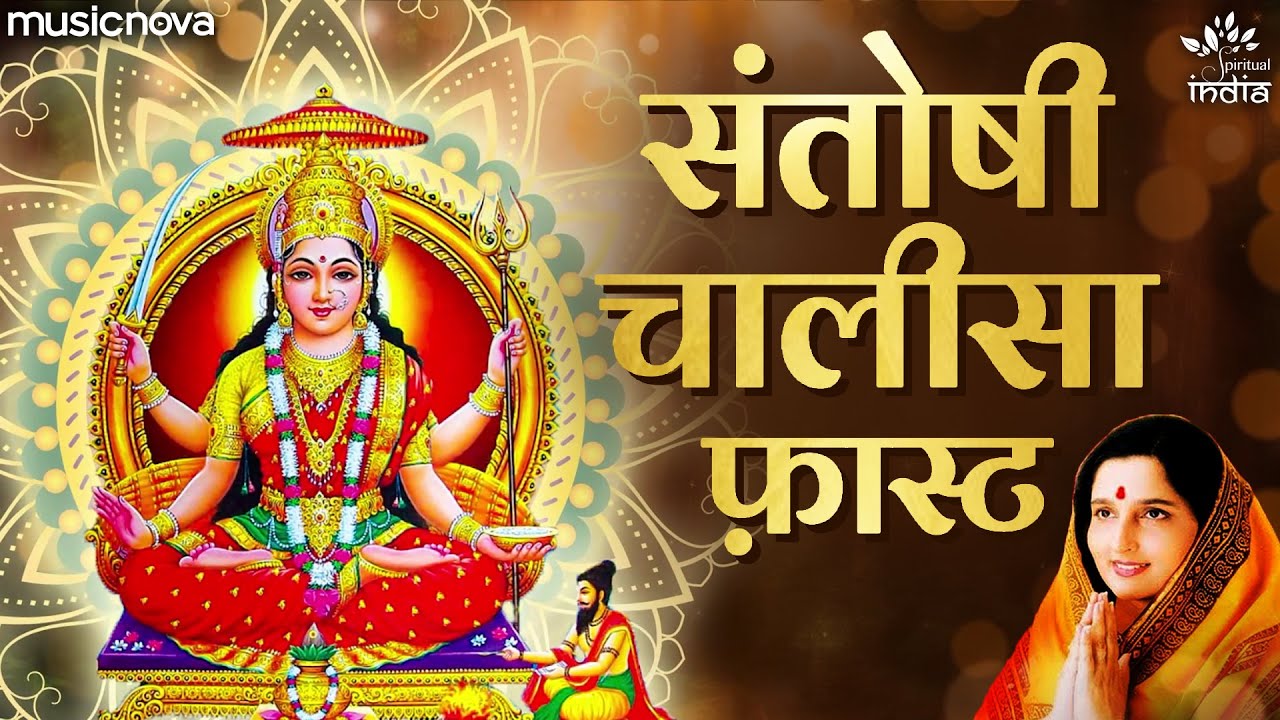
Santoshi Mata herself is described as the daughter of Ganesh, born from the meditation of Ganesh and his consorts Riddhi-Siddhi on Raksha Bandhan day, when their nephews Shubha and Labha (sons of Krittika) asked for a sister to tie rakhi to. This origin myth is preserved in the popular tradition rather than the older Puranas. Iconographically she is depicted four-armed (verse 6), seated on a peacock (verse 7), with a cow nearby (verse 7), holding a sword and a bowl. Her bhog is gud-chana – jaggery and roasted gram (verse 29) – which is among the simplest offerings in any Hindu vrat tradition. The simplicity of the offering is itself part of the teaching: Santoshi (literally "the contented one") is pleased by humble service, not lavish ritual.
The Chalisa's wider companions are the Ganesh Chalisa (Santoshi's father, paired in any Santoshi worship – Ganesh first, always), the Durga Chalisa (the wider Devi form named in verses 11-15), the Lakshmi Chalisa (also worshipped on Fridays, often paired with Santoshi for household prosperity), and the Parvati Chalisa (the older Devi form, mother of Ganesh and grandmother in the Santoshi lineage). Many households who keep the 16-Friday vrat recite all four during the week.
How to recite
A simple, sustainable approach. Nothing here is a hard rule – devotion shapes the form, not the other way around.
-
Preparation
Bathe and wear clean clothes if you can – traditionally red or pink, the colours associated with Santoshi Mata and the Friday vrat. Sit in a clean space facing east or north, or before your home Santoshi murti or photograph. The traditional offerings are gud-chana (jaggery and roasted gram, the signature bhog), a small ghee diya, red or pink flowers (rose, hibiscus, or marigold), a piece of red mauli thread, and an incense stick of any sweet fragrance. Important rule of the vrat: on Fridays of the Shukravar Vrat, do not eat or offer anything sour – no tamarind, no lemon, no curd, no fruits with sour edge. This is the most-emphasised rule of Santoshi worship.
-
Posture and start
Sit cross-legged on a mat, or in a chair, with your spine comfortably straight. Bow once. Take a moment of silence to settle the mind. If you are reciting on a Shukravar Vrat day or for a specific intention (marriage, fertility, household harmony, financial reset), offer a brief sankalp naming the date, the place, and the matter at hand. Begin with the opening doha (Shri Ganpati pad naay sir...) slowly – note the dual invocation of Ganesh and Saraswati. Saying it aloud has its own merit because the sound itself is an offering, but silent reciting works just as well during travel or at the desk.
-
Recitation
Move through the forty chaupais without rushing. Verses 4-7 describe Santoshi's iconography (crown, earrings, four arms, the cow, the peacock). Verses 11-15 identify her with the wider Devi forms. Verses 24-32 are the practitioner-facing verses describing what the steady devotee receives – often slowed down particularly. Verses 28-31 describe the Shukravar Vrat structure and are read with awareness on Friday mornings. End with the closing doha. The full recitation takes about seven minutes spoken aloud at a comfortable pace. Devotion matters more than perfect pronunciation.
-
After
Sit quietly with eyes closed for a moment. Many people end with the bija mantra Om Shri Santoshi Mahamayayai Namah recited 11 or 21 times. Offer the gud-chana bhog and take a small portion as prasad, sharing it with family members. The udyapan rule: if you are keeping the 16-Friday vrat, on the seventeenth Friday perform the udyapan ceremony – feed eight young boys (under 12 years) with kheer-puri and gud-chana, give them dakshina, and break the long fast. Many traditions also forbid touching or offering sour food in the household on the day of the vrat. Some traditions add a closing line of namaskar to one's own guru and family deity (kuldevta).
-
Daily practice and special days
One paath a day – morning – is enough for steady daily practice. Fridays are especially auspicious. The 16-Friday Shukravar Vrat (Solah Shukravar) is the major Santoshi anushthan – sixteen consecutive Fridays, with the Chalisa morning paath, gud-chana bhog, the no-sour rule, and a closing udyapan. The vrat is most commonly begun on the first Friday after a major life event (engagement, marriage, conception, job change, business start). Some also keep Saat Shukravar (seven Fridays) as a shorter form, named in verse 34. Beyond Fridays, Navratri and major Devi festivals are also recitation days, especially when the Chalisa is paired with the wider Devi Chalisas for Mahalakshmi-Mahasaraswati-Mahakali worship.