On this page
Lyrics with meaning
The complete Lakshmi Chalisa – two opening dohas, forty chaupais, and a closing doha. A short English meaning sits below every verse. Toggle the script to read in Devanagari, romanized, or both side-by-side.
मातु लक्ष्मी करि कृपा, करो हृदय में वास। मनोकामना सिद्ध करि, पुरवहु मेरी आस॥
Matu Lakshmi kari kripa, karo hriday mein vas. Manokamna siddh kari, puravahu meri aas.
Mother Lakshmi, show grace and dwell in my heart. Fulfil my heartfelt wishes, and answer my hope.
यही मोर अरदास, हाथ जोड़ विनती करूँ। सबविधि करौ सुवास, जय जननि जगदंबिका॥
Yahi mor ardas, haath jod vinti karun. Sabvidhi karau suvas, jai janani Jagadambika.
This is my one petition – with folded hands, I plead. In every way, fill me with auspicious fragrance. Hail, mother of the worlds, Jagadambika.
सिन्धु सुता मैं सुमिरों तोही। ज्ञान बुद्धि विद्या दे मोही॥
Sindhu suta main sumiron tohi. Gyan buddhi vidya de mohi.
Daughter of the ocean, I remember you. Grant me wisdom, intellect, and learning.
तुम समान न ही कोई उपकारी। सब विधि पुरवहु आस हमारी॥
Tum saman na hi koi upkari. Sab vidhi puravahu aas hamari.
There is no other benefactor like you. In every way, fulfil our hopes.
जय जय जय जननी जगदम्बा। सबकी तुम ही हो अवलम्बा॥
Jai jai jai janani Jagadamba. Sabki tum hi ho avalamba.
Hail, hail, hail – mother of the world, Jagadamba. You alone are the support of all.
तुम हो सब घट घट के वासी। विनती यही हमारी खासी॥
Tum ho sab ghat ghat ke vasi. Vinti yahi hamari khasi.
You dwell in every heart. This is our particular plea.
जग जननी जय सिन्धुकुमारी। दीनन की तुम हो हितकारी॥
Jag janani jai sindhu-kumari. Dinan ki tum ho hitkari.
Hail, mother of the world, daughter of the ocean. You are the benefactor of the helpless.
बिनवों नित्य तुमहिं महारानी। कृपा करो जग जननि भवानी॥
Binvon nitya tumhin Maharani. Kripa karo jag janani Bhavani.
Daily I pray to you, great queen. Show grace, mother of the world, Bhavani.
केहि विधि स्तुति करौं तिहारी। सुधि लीजै अपराध बिसारी॥
Kehi vidhi stuti karaun tihari. Sudhi lijai aparadh bisari.
How can I sing your praise adequately? Take notice of me; forget my faults.
कृपा दृष्टि चितवो मम ओरी। जग जननी विनती सुन मोरी॥
Kripa drishti chitvo mam ori. Jag janani vinti sun mori.
Cast a glance of grace toward me. Mother of the world, hear my plea.
ज्ञान बुद्धि सब सुख का दाता। संकट हरो हमारी माता॥
Gyan buddhi sab sukh ka data. Sankat haro hamari mata.
Giver of wisdom, intellect, and every happiness. Lift our troubles, O Mother.
क्षीर सिन्धु जब विष्णु मथायो। चौदह रत्न सिन्धु में पायो॥
Ksheer Sindhu jab Vishnu mathayo. Chaudah ratna Sindhu mein payo.
When Vishnu churned the milk ocean, fourteen jewels emerged from the ocean. (The Samudra Manthan – the great churning where Lakshmi appeared.)
चौदह रत्न में तुम सुखरासी। सेवा कियो प्रभु बन दासी॥
Chaudah ratna mein tum sukh-rasi. Seva kiyo Prabhu ban dasi.
Among the fourteen jewels you were the very treasury of joy. Becoming the Lord's servant, you served him.
जो जो जन्म प्रभु जहां लीना। रूप बदल तहँ सेवा कीन्हा॥
Jo jo janma Prabhu jahan lina. Roop badal tahan seva kinha.
Wherever and whenever the Lord took birth, changing form, you served him there.
स्वयं विष्णु जब नर तनु धारा। लीन्हेउ अवधपुरी अवतारा॥
Swayam Vishnu jab nar tanu dhara. Linheu Avadhpuri avtara.
When Vishnu himself took human form, he descended in Ayodhya as Ram.
तब तुम प्रगट जनकपुर माहीं। सेवा कियो हृदय पुलकाहीं॥
Tab tum pragat Janakpur mahin. Seva kiyo hriday pulkahin.
You then appeared in Janakpur as Sita. With a heart full of joy, you served him.
अपनायो तोहि अन्तर्यामी। विश्व विदित त्रिभुवन के स्वामी॥
Apnayo tohi antaryami. Vishva vidit tribhuvan ke swami.
The inner-knower accepted you as his own. He – the lord of the three worlds – is known throughout the universe.
तुम सम प्रबल शक्ति नहिं आनि। कहँ लौं महिमा कहौं बखानी॥
Tum sam prabal shakti nahin aani. Kahan laun mahima kahaun bakhani.
There is no other power as mighty as you. How far can I describe your greatness?
मन क्रम वचन करै सेवकाई। मन इच्छित वांछित फल पाई॥
Man kram vachan karai sevkai. Man-icchit vanchhit phal pai.
Whoever serves you in thought, deed, and word. Receives every desired fruit of the heart.
तजि छल कपट और चतुराई। पूजहिं विविध भाँति मनलाई॥
Taji chhal kapat aur chaturai. Pujahin vividh bhanti man-lai.
Setting aside cunning, deceit, and clever schemes. They worship you in various ways with focused mind.
और हाल मैं कहौं बुझाई। जो यह पाठ करै मन लाई॥
Aur haal main kahaun bujhai. Jo yah paath karai man lai.
And let me explain another matter clearly. Whoever recites this paath with full attention...
ताको कोई कष्ट न होई। मन इच्छित पावै फल सोई॥
Tako koi kasht na hoi. Man-icchit pavai phal soi.
...no trouble comes to them. They receive the fruit their heart desires.
त्राहि त्राहि जय दुख निवारिणी। ताप भव बंधन हारिणी॥
Trahi trahi jai dukh-nivarini. Taap bhav bandhan harini.
Save us, save us – hail, remover of sorrow. You who lift the heat of the world and the bondage of existence.
जो यह पढ़े और पढ़ावे। ध्यान लगाकर सुनै सुनावै॥
Jo yah padhe aur padhave. Dhyan lagakar sunai sunavai.
Whoever reads it and has it read aloud. Whoever listens with focus and lets others listen...
ताको कोई न रोग सतावे। पुत्र आदि धन सम्पत्ति पावै॥
Tako koi na rog satave. Putra adi dhan sampatti pavai.
...no disease can torment them. They receive children, wealth, and property. (A verse of devotional faith, not a replacement for medical care.)
पुत्रहीन अरु संपतिहीना। अन्ध बधिर कोढ़ी अति दीना॥
Putrahin aru sampatihina. Andh badhir kodhi ati dina.
Those without children and those without wealth. Those who are blind, deaf, leprous, or extremely afflicted – the verse names the older idiom of suffering, calling on the Mother for relief.
विप्र बोलाय के पाठ करावै। शंका दिल में कभी न लावै॥
Vipra bolaay ke paath karavai. Shanka dil mein kabhi na lavai.
Let them call a brahmin and have the paath recited. And never let doubt enter the heart.
पाठ करावै दिन चालीसा। तापर कृपा करें गौरीसा॥
Paath karavai din chalisa. Taapar kripa karein Gaurisa.
Have the paath recited for forty days. Gaurisa (Shiva, lord of Gauri) showers grace upon them.
सुख सम्पत्ति बहुत सो पावै। कमी नहीं काहु की आवै॥
Sukh sampatti bahut so pavai. Kami nahin kahu ki avai.
They receive abundant happiness and prosperity. No deficiency comes upon them in any matter.
बारह मास करै सो पूजा। तेहि सम धन्य और नहिं दूजा॥
Barah maas karai so puja. Tehi sam dhanya aur nahin duja.
Whoever offers worship through all twelve months of the year. There is no other as blessed as them.
प्रतिदिन पाठ करै मनमाहीं। उन सम कोई जग में कहुँ नाहीं॥
Pratidin paath karai man-mahin. Un sam koi jag mein kahun nahin.
Whoever recites the paath daily, with the mind absorbed. There is no one in the world like them.
बहु विधि क्या मैं करौं बड़ाई। लेय परीक्षा ध्यान लगाई॥
Bahu vidhi kya main karaun badai. Ley pariksha dhyan lagai.
How much praise can I offer in many ways? Test it for yourself, with focused attention.
करि विश्वास करै व्रत नेमा। होय सिद्ध उपजै उर प्रेमा॥
Kari vishvas karai vrat nema. Hoy siddh upjai ur prema.
With faith, keep the vow and the discipline. The practice succeeds, and love rises in the heart.
जय जय जय लक्ष्मी भवानी। सब में व्यापित हो गुणखानी॥
Jai jai jai Lakshmi Bhavani. Sab mein vyapit ho gun-khani.
Hail, hail, hail – Lakshmi Bhavani. You pervade all beings, treasury of every quality.
तुम्हारो तेज प्रबल जग माहीं। तुम सम कोउ दयालु कहुँ नाहिं॥
Tumharo tej prabal jag mahin. Tum sam kou dayalu kahun nahin.
Your radiance is mighty in the world. There is no one as compassionate as you anywhere.
मोहि अनाथ की सुध अब लीजै। संकट काटि भक्ति मोहि दीजै॥
Mohi anath ki sudh ab lijai. Sankat kati bhakti mohi dijai.
Take notice now of me, the helpless one. Cut away my troubles and grant me devotion.
भूल चूक करि क्षमा हमारी। दर्शन दीजै दशा निहारी॥
Bhool chook kari kshama hamari. Darshan dijai dasha nihari.
Forgive my errors and oversights. Seeing my condition, grant me your darshan.
केहि प्रकार मैं करौं बड़ाई। ज्ञान बुद्धि मोहि नहिं अधिकाई॥
Kehi prakar main karaun badai. Gyan buddhi mohi nahin adhikai.
In what way can I offer your praise? I have no great wisdom or intellect.
बिन दर्शन व्याकुल अधिकारी। तुमहि अछत दुख सहते भारी॥
Bin darshan vyakul adhikari. Tumhi achhat dukh sahte bhari.
Without your darshan, the deserving one is restless. Even though you exist, I bear heavy sorrow.
नहिं मोहि ज्ञान बुद्धि है मन में। सब जानत हो अपने मन में॥
Nahin mohi gyan buddhi hai man mein. Sab janat ho apne man mein.
I have no real wisdom or intellect in my mind. You know everything in your own mind.
रूप चतुर्भुज करके धारण। कष्ट मोर अब करहु निवारण॥
Roop chaturbhuj karke dharan. Kasht mor ab karahu nivaran.
Taking on your four-armed form. Now remove my suffering.
त्राहि त्राहि दुख हारिणी, हरो बेगि सब त्रास। जयति जयति जय लक्ष्मी, करो दुश्मन का नाश॥
Trahi trahi dukh-harini, haro begi sab tras. Jayati jayati jai Lakshmi, karo dushman ka nash.
Save us, save us – remover of sorrow. Quickly lift away every fear. Victory, victory, victory to Lakshmi. Destroy what stands against us.
रामदास धरि ध्यान नित, विनय करत कर जोर। मातु लक्ष्मी दास पै, करहु दया की कोर॥
Ramdas dhari dhyan nit, vinay karat kar jor. Matu Lakshmi das pai, karahu daya ki kor.
Ramdas, holding you in steady meditation, prays with folded hands. Mother Lakshmi, on this servant of yours, turn even a corner of your kindness. (The composer's signature line – the verse that names the author.)
Why this chalisa
What the Lakshmi Chalisa is recited for, and what people turn to it for.
Steadiness in livelihood
Verses 17-20 describe the practitioner who serves Lakshmi in thought, deed, and word, and who recites the paath with attention – they receive the fruit their heart desires. The teaching is not magic. It is that a daily seven-minute return to the Mother of abundance gives the inner steadiness that good work, careful spending, and patient waiting all need. Many small business owners and householders keep the Lakshmi Chalisa as their morning anchor.
Diwali and the home Lakshmi puja
The Chalisa is the central recitation of Diwali – Lakshmi Puja on the Amavasya night of Kartik. Many households recite eleven or twenty-one paaths through the evening, alongside the formal aarti. The full evening sequence usually starts with the Ganesh Chalisa (Ganesh first, always), then the Lakshmi Chalisa, then the Lakshmi aarti. Dhanteras two days earlier and Sharad Purnima in the previous month are also major recitation days.
Companion to the wider Devi worship
Verses 14-15 identify Lakshmi with Sita, Vishnu's consort in the Ramayana – tying her to the wider household worship of Vishnu and his avatars. The Chalisa is often recited together with the Vishnu Chalisa on Thursdays, with the Saraswati Chalisa at the start of academic years, and with the Durga Chalisa during Navratri – the three goddesses of the Tridevi together.
Help during financial difficulty
Verses 24-27 directly name those without children, without wealth, or in extreme distress, and prescribe a forty-day paath cycle as the older practice. Many devotees commit to a 40-day or 41-day anushthan during a financial reset – a job change, a business setback, a sudden expense, or the start of a new venture. The teaching is that steadiness of practice, not intensity, is what carries the period through. (This is a verse of devotional faith, not a replacement for sound financial planning or professional advice.)
Pairing with Kuber for wealth practice
In the older household tradition, Lakshmi is the goddess of wealth as flow and abundance, while Kuber is the deity of wealth as preservation and store. Many businesses recite both Chalisas at the start of the financial year, at Dhanteras, and at the opening of a new account or shop. Pairing the two is the older idiom for the wish that money should both come in and stay.
Festival anchor across the Hindu year
Beyond Diwali, the Lakshmi Chalisa anchors several festivals across the year. Akshaya Tritiya in April-May, Varalakshmi Vrat in the south during Shravan (July-August), Sharad Purnima in October, Dhanteras two days before Diwali, Margashirsha Guruvar Thursdays through that month – each has the Chalisa at its centre. Pairing it with the Mahalakshmi Chalisa on these days is common in Maharashtra and the south.
Origin
The Lakshmi Chalisa is signed in its closing doha by Ramdas – a saint-poet whose name appears in the colophon: "Ramdas dhari dhyan nit, vinay karat kar jor." Beyond this signature, very little is known about Ramdas with certainty. The name was a common saint-name in north India between the 16th and 19th centuries (the Maharashtra saint Samartha Ramdas, the Punjab Ramdas of Sikh tradition, several lesser-known Vaishnava poets), and the colophon of the Lakshmi Chalisa cannot be tied to any one of them with confidence. Many published copies attribute the Chalisa simply to "tradition" – an honesty worth preserving.
The text does not record a date of composition. By language and style the Lakshmi Chalisa is generally placed in the 17th-19th century CE, written in a simple Hindi with Awadhi influence – the everyday idiom of north India in that period, not Sanskrit kept aside for scholars. The Chalisa is shorter than the Hanuman Chalisa (forty-three verses by Tulsidas) and roughly the same length as the Saraswati Chalisa and Durga Chalisa – the same forty-verse form, framed by an opening doha and sortha, and closed by a two-doha signature.
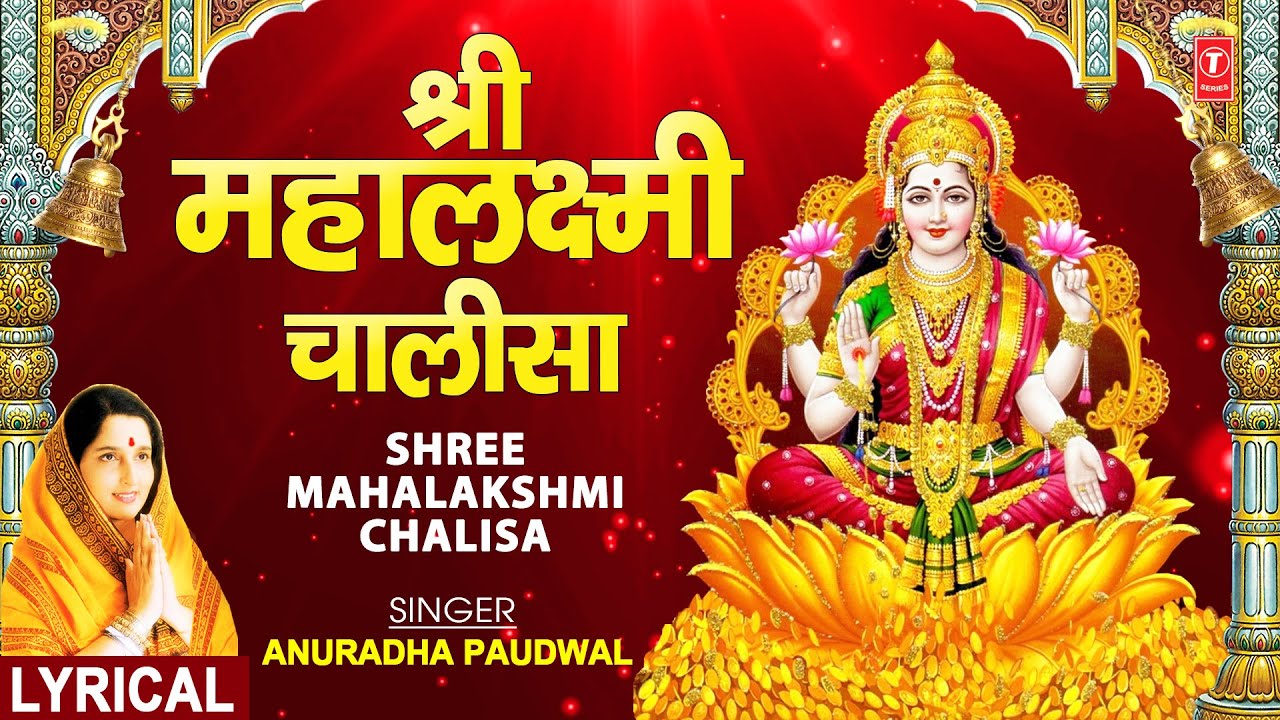
Lakshmi herself is the consort of Vishnu and the goddess of wealth, abundance, prosperity, and good fortune. The chaupais trace her core mythology: she emerged during the Samudra Manthan – the great churning of the milk ocean (verses 10-11) – when devas and asuras together churned for the nectar of immortality. Among the fourteen jewels that arose, she chose Vishnu as her consort. From there, she descends with him into each of his avatars: as Sita to his Ram in Ayodhya (verses 13-14), as Rukmini to his Krishna, as Padmavati to his Venkateshwara. Iconographically she is depicted four-armed (verse 39), seated on a pink lotus, with elephants pouring water over her – the Gaja Lakshmi form. The eight forms (Ashta Lakshmi) preserved in temple worship are Adi, Dhana, Dhanya, Gaja, Santana, Veera, Vijaya, and Aishwarya – each a face of abundance.
The Chalisa's wider companions are the Ganesh Chalisa (paired with Lakshmi for Diwali; Ganesh first, always – the obstacle removed before the abundance is invoked), the Vishnu Chalisa (her consort, recited with her on Thursdays and Fridays), the Saraswati Chalisa (the sister-goddess of the Tridevi, knowledge alongside abundance), the Kuber Chalisa (the deity of wealth as preservation, paired with Lakshmi at financial year-ends and shop openings), and the Mahalakshmi Chalisa (the extended form recited especially in Maharashtra and the south).
How to recite
A simple, sustainable approach. Nothing here is a hard rule – devotion shapes the form, not the other way around.
-
Preparation
Bathe and wear clean clothes if you can – traditionally pink, red, or yellow, the colours associated with Lakshmi. Sit in a clean space facing east or north, or before your home Lakshmi murti or picture if you have one. The traditional offerings are a lotus flower (or any pink or red flower if a lotus is not available), a small ghee diya, a few grains of rice mixed with turmeric (akshat), a piece of fruit or a small sweet, and an incense stick of sandalwood or rose. None of this is strictly required. The Chalisa was written for everyday recitation, with or without samagri.
-
Posture and start
Sit cross-legged on a mat, or in a chair, with your spine comfortably straight. Bow once. Take a moment of silence to settle the mind. If you are reciting before a specific event – a business opening, a financial decision, the start of the financial year – offer a brief sankalp naming the date, the place, and the matter at hand. Begin with the opening doha (Matu Lakshmi kari kripa...) slowly, then the sortha. Saying it aloud has its own merit because the sound itself is an offering, but silent reciting works just as well during travel or at the desk.
-
Recitation
Move through the thirty-nine chaupais without rushing. Verses 10-15 narrate Lakshmi's emergence from the milk ocean and her descent as Sita – often read with a small pause at each transition. Verses 19-31 are the practitioner-facing verses, describing what the steady reciter receives – many devotees slow these down particularly. End with the two closing dohas (the second names Ramdas – the composer's signature). The full recitation takes about seven minutes spoken aloud at a comfortable pace. Devotion matters more than perfect pronunciation.
-
After
Sit quietly with eyes closed for a moment. Many people end with the bija mantra Om Shrim Mahalakshmiyai Namah recited 11 or 21 times – shrim is the seed-syllable of Lakshmi. If you have a wish or a difficulty in mind, mentally offer the punya of the recitation toward it before getting up. Some traditions add a closing line of namaskar to one's own guru and family deity (kuldevta), and an offering of a small portion of the prasad to the household.
-
Daily practice and special days
One paath a day – morning or evening – is enough for steady daily practice. Fridays are especially auspicious. Diwali (Lakshmi Puja on Amavasya of Kartik) is the major festival – households install or wash the home Lakshmi murti, light a row of diyas, and recite 11 or 21 paaths through the evening. Dhanteras two days before Diwali, Sharad Purnima in October, Akshaya Tritiya in April-May, Varalakshmi Vrat in Shravan, and the four Margashirsha Guruvars in north India are all major recitation days. For specific wishes – a business opening, a financial reset, a housewarming – the older practice is 11, 21, 41, or 108 paaths over a fixed period, paired with the Ganesh Chalisa at the start.