On this page
Lyrics with meaning
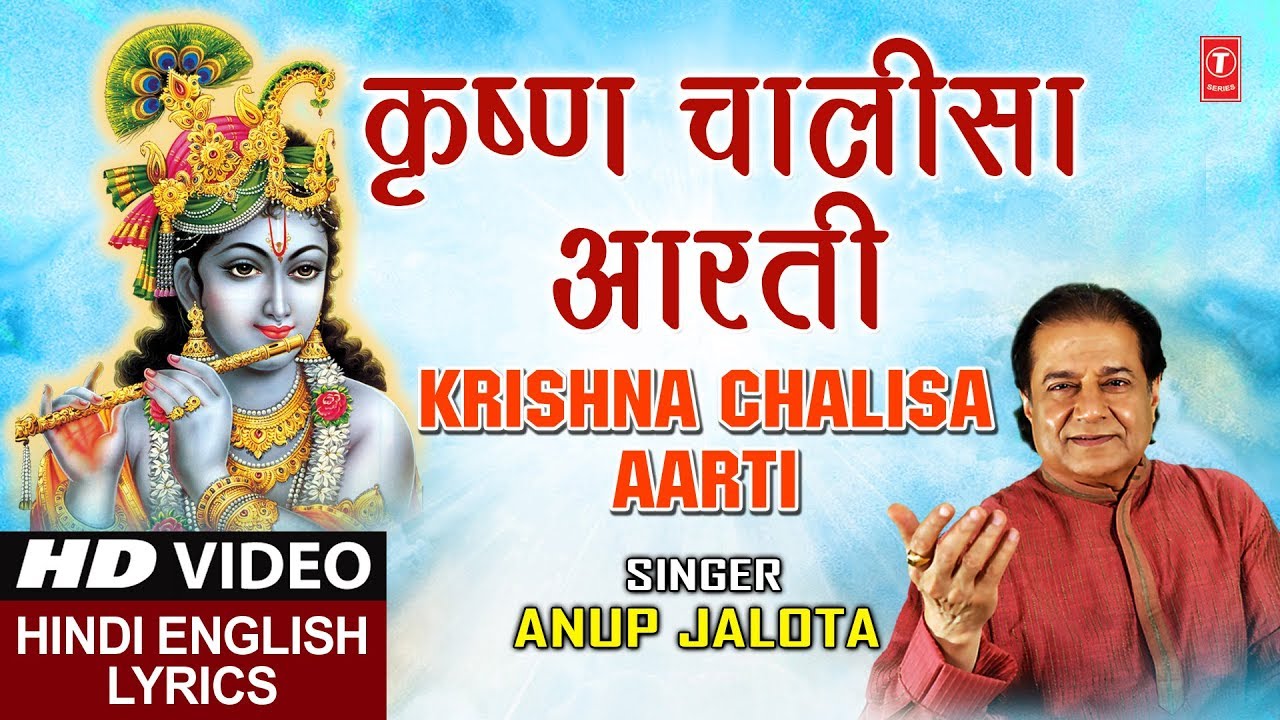
The complete Krishna Chalisa – two opening dohas, forty chaupais, and a closing doha. A short English meaning sits below every verse. Toggle the script to read in Devanagari, romanized, or both side-by-side.
बंशी शोभित कर मधुर, नील जलद तन श्याम। अरुण अधर जनु बिम्बफल, नयन कमल अभिराम॥
Banshi shobhit kar madhur, neel jalad tan shyam. Arun adhar janu bimba-phal, nayan kamal abhiram.
His hand holds a sweet flute. His body is dark like a rain cloud. His red lips are like the bimba fruit. His eyes are lotuses, full of beauty.
पूर्ण इन्द्र, अरविन्द मुख, पीताम्बर शुभ साज। जय मनमोहन मदन छवि, कृष्णचन्द्र महाराज॥
Purna indra, aravind mukh, pitambar shubh saj. Jai manmohan madan chhavi, Krishnachandra Maharaj.
His face is like the full moon, lotus-like. He is adorned in shining yellow silk. Hail to the heart-stealer, the very form of love – Krishnachandra Maharaj.
जय यदुनन्दन जय जगवन्दन। जय वसुदेव देवकी नन्दन॥
Jai Yadunandan jai Jagvandan. Jai Vasudev Devaki Nandan.
Hail, son of the Yadu lineage; hail, the worship-worthy of the world. Hail, son of Vasudeva and Devaki.
जय यशुदा सुत नन्द दुलारे। जय प्रभु भक्तन के दृग तारे॥
Jai Yashuda-sut Nand-dulare. Jai Prabhu bhaktan ke drig-tare.
Hail, son of Yashoda, beloved of Nanda. Hail, Lord, you are the very pupils of the eyes of your devotees.
जय नट-नागर नाग नथैया। कृष्ण कन्हैया धेनु चरैया॥
Jai Nat-Nagar Naag-nathaiya. Krishna Kanhaiya dhenu charaiya.
Hail, dancer-prince, tamer of the serpent. Krishna Kanhaiya, the cowherd grazing the cattle.
पुनि नख पर प्रभु गिरिवर धारो। आओ दीनन कष्ट निवारो॥
Puni nakh par Prabhu girivar dharo. Aao dinan kasht nivaro.
Lord, you held Mount Govardhan upon your fingernail. Come, lift the suffering of the helpless.
वंशी मधुर अधर धरि टेरौ। होवे पूर्ण विनय यह मेरौ॥
Banshi madhur adhar dhari tero. Hove puran vinay yah mero.
Hold your sweet flute to your lips and call. Let this prayer of mine be fulfilled.
आओ हरि पुनि माखन चाखो। आज लाज भारत की राखो॥
Aao Hari puni makhan chakho. Aaj laaj Bharat ki rakho.
Come, Hari, taste the butter once more. Today, preserve the honour of Bharat.
गोल कपोल, चिबुक अरुणारे। मृदु मुस्कान मोहिनी डारे॥
Gol kapol, chibuk arunare. Mridu muskaan mohini dare.
Round cheeks, a reddish chin. A soft smile that casts a spell of love.
राजित राजिव नयन विशाला। मोर मुकुट वैजन्तीमाला॥
Rajit rajiv nayan vishala. Mor mukut vaijantimala.
Lotus-like eyes, large and shining. A peacock-feather crown and the vaijanti garland.
कुण्डल श्रवण, पीत पट आछे। कटि किंकिणी काछनी काछे॥
Kundal shravan, pit pat aache. Kati kinkini kachhani kaache.
Earrings on his ears, fine yellow silk above. A jingling waistband and a tied dhoti below.
नील जलज सुन्दर तनु सोहे। छवि लखि सुर नर मुनिमन मोहे॥
Neel jalaj sundar tanu sohe. Chhavi lakhi sur nar muni-man mohe.
His body shines beautifully like a blue lotus. Seeing this image, gods, men, and sages are enchanted.
मस्तक तिलक, अलक घुंघराले। आओ कृष्ण बांसुरी वाले॥
Mastak tilak, alak ghunghrale. Aao Krishna bansuri-wale.
A tilak on the forehead, curly locks of hair. Come, Krishna, the one with the flute.
करि पय पान पुतनहि तारयो। अका बका कागासुर मारयो॥
Kari pay-paan Putanahi taryo. Aka Baka Kagasur maryo.
Drinking her milk, you liberated the demoness Putana. You slew the demons Aka, Baka, and Kagasur.
मधुवन जलत अग्नि जब ज्वाला। भै शीतल लखतहिं नन्दलाला॥
Madhuvan jalat agni jab jwala. Bhai sheetal lakhtahin Nandlala.
When fire blazed and threatened to burn the Madhuvan forest. Just by Krishna's glance, it became cool.
सुरपति जब ब्रज चढ़यो रिसाई। मूसर धार वारि वर्षाई॥
Surpati jab Braj chadhyo risai. Moosar dhar vari varshai.
When Indra, lord of gods, rose in fury against Braj. He poured down rain in torrents like pestles.
लगत-लगत व्रज चहन बहायो। गोवर्धन नख धारि बचायो॥
Lagat-lagat Vraj chahan bahayo. Govardhan nakh dhari bachayo.
Just as Vraj was about to be swept away. You lifted Mount Govardhan on your fingernail and saved it.
लखि यशुदा मन भ्रम अधिकाई। मुख महं चौदह भुवन दिखाई॥
Lakhi Yashuda man bhram adhikai. Mukh mahan chaudah bhuvan dikhai.
Seeing Yashoda's mind grow more confused. You showed the fourteen worlds inside your open mouth. (When Yashoda asked Krishna to open his mouth to check whether he had eaten mud, she saw the entire universe within.)
दुष्ट कंस अति उधम मचायो। कोटि कमल जब फूल मंगायो॥
Dusht Kans ati udham machayo. Koti kamal jab phool mangayo.
The wicked Kamsa created many disturbances. He demanded ten million lotuses to test you.
नाथि कालियहिं तब तुम लीन्हें। चरण चिन्ह दै निर्भय कीन्हें॥
Naathi Kaliyahin tab tum linhen. Charan chinh dai nirbhay kinhen.
You then subdued the serpent Kaaliya. With the mark of your feet, you made the river fearless.
करि गोपिन सँग रास विलासा। सबकी पूरण करी अभिलाषा॥
Kari gopin sang raas vilasa. Sabki puran kari abhilasha.
With the gopis you played the rasa-lila. You fulfilled the desire of every one of them.
केतिक महा असुर संहारयो। कंसहि केस पकड़ि दै मारयो॥
Ketik maha asur sanharyo. Kansahi kes pakri dai maryo.
How many great demons you destroyed. Catching Kamsa by the hair, you struck him down.
मात-पिता की बन्दि छुड़ाई। उग्रसेन कहं राज दिलाई॥
Maat-pita ki bandi chhudai. Ugrasen kahan raj dilai.
You freed your mother and father from prison. You gave the kingdom back to Ugrasen, the rightful king.
महि से मृतक छहों सुत लायो। मातु देवकी शोक मिटायो॥
Mahi se mritak chhahon sut layo. Matu Devaki shok mitayo.
From the realm of the dead, you brought back the six dead sons of Devaki. And so dispelled mother Devaki's sorrow.
भौमासुर मुर दैत्य संहारी। लाये षट दश सहसकुमारी॥
Bhaumasur Mur daitya sanhari. Laye shat dash sahas-kumari.
You destroyed the demons Bhaumasur and Mura. And brought back the sixteen thousand maidens they had imprisoned.
दै भीमहिं तृण चीर सहारा। जरासिंधु राक्षस कहं मारा॥
Dai Bhimahin trin cheer sahara. Jarasindhu rakshas kahan mara.
You showed Bhima how to tear a blade of grass for support. And so the demon Jarasandha was killed. (The mythic moment when Bhima killed Jarasandha by tearing him in half, taking the cue from Krishna's gesture.)
असुर बकासुर आदिक मारयो। भक्तन के तब कष्ट निवारयो॥
Asur Bakasur aadik maryo. Bhaktan ke tab kasht nivaryo.
You slew demons like Bakasura and many others. And so removed the suffering of your devotees.
दीन सुदामा के दुख टारयो। तंदुल तीन मूँठ मुख डारयो॥
Deen Sudama ke dukh taaryo. Tandul teen moonth mukh daaryo.
You lifted the suffering of poor Sudama. Three handfuls of beaten rice, you placed in your mouth. (The famous story of Krishna's childhood friend Sudama bringing humble rice as offering, and Krishna making him wealthy in return.)
प्रेम के साग विदुर घर माँगे। दुर्योधन के मेवा त्यागे॥
Prem ke saag Vidur ghar mange. Duryodhan ke meva tyage.
You asked for simple greens at Vidura's house out of love. And refused the rich food at Duryodhana's palace.
लखी प्रेम की महिमा भारी। ऐसे श्याम दीन हितकारी॥
Lakhi prem ki mahima bhari. Aise Shyam deen hitkari.
Behold the great glory of love. Such is Shyam – the benefactor of the lowly.
भारत के पारथ रथ हाँके। लिये चक्र कर नहिं बल थाके॥
Bharat ke Parth rath haanke. Liye chakra kar nahin bal thake.
You drove the chariot of Arjuna in the Bharat war. Lifting your discus, your strength never tired.
निज गीता के ज्ञान सुनाए। भक्तन हृदय सुधा वर्षाए॥
Nij Gita ke gyan sunae. Bhaktan hriday sudha varshae.
You spoke the wisdom of your own Gita. Showering nectar into the hearts of devotees.
मीरा थी ऐसी मतवाली। विष पी गई बजाकर ताली॥
Mira thi aisi matwali. Vish pi gayi bajakar tali.
Mira was such an intoxicated devotee. She drank the poison while clapping in joy. (Mira Bai's legendary survival of the poison sent by her family.)
राना भेजा साँप पिटारी। शालिग्राम बने बनवारी॥
Rana bheja saanp pitari. Shaligram bane Banwari.
The Rana sent her a basket with a cobra. The cobra became a Shaligram – Banwari himself.
निज माया तुम विधिहिं दिखायो। उर ते संशय सकल मिटायो॥
Nij maya tum vidhihin dikhayo. Ur te sanshay sakal mitayo.
You showed your divine maya to Brahma himself. And so removed every doubt from his heart. (The episode where Brahma stole the cowherd boys, and Krishna became all of them.)
तब शत निन्दा करि तत्काला। जीवन मुक्त भयो शिशुपाला॥
Tab shat ninda kari tatkala. Jivan mukt bhayo Shishupala.
When Shishupala had completed a hundred curses immediately. He was liberated even while alive. (The story of Krishna allowing Shishupala one hundred offences before slaying him – granting him moksha.)
जबहिं द्रौपदी टेर लगाई। दीनानाथ लाज अब जाई॥
Jabhin Draupadi ter lagai. Dinanath laaj ab jai.
When Draupadi cried out in distress: 'Lord of the helpless, my honour is leaving me now.'
तुरतहिं वसन बने नन्दलाला। बढ़े चीर भै अरि मुख काला॥
Turtahin vasan bane Nandlala. Badhe cheer bhai ari mukh kala.
Immediately Nandlala became her cloth. The garment kept extending, and the faces of the enemy darkened in shame.
अस अनाथ के नाथ कन्हैया। डूबत भँवर बचावै नैया॥
As anath ke nath Kanhaiya. Doobat bhanwar bachavai naiya.
Such is Kanhaiya – the lord of those without a lord. He saves the boat sinking in the whirlpool.
‘सुन्दरदास’ आस उर धारी। दया दृष्टि कीजै बनवारी॥
‘Sundardas’ aas ur dhari. Daya drishti kijai Banwari.
Sundardas holds this hope in his heart. Cast a glance of grace, O Banwari. (The composer's signature line – the verse that names the author.)
नाथ सकल मम कुमति निवारो। क्षमहु बेगि अपराध हमारो॥
Nath sakal mam kumati nivaro. Kshamahu begi aparadh hamaro.
Lord, remove all my wicked thoughts. Quickly forgive my offences.
खोलो पट अब दर्शन दीजै। बोलो कृष्ण कन्हैया की जै॥
Kholo pat ab darshan dijai. Bolo Krishna Kanhaiya ki jai.
Open the doors and grant me your darshan now. Cry out: hail to Krishna Kanhaiya.
यह चालीसा कृष्ण का, पाठ करै उर धारि। अष्ट सिद्धि नवनिधि फल, लहै पदारथ चारि॥
Yah Chalisa Krishna ka, paath karai ur dhari. Ashta siddhi navnidhi phal, lahai padarath chari.
Whoever recites this Krishna Chalisa, holding it in the heart. Receives the eight siddhis, the nine treasures, and the four fruits of life.
Why this chalisa
What the Krishna Chalisa is recited for, and what people turn to it for.
Daily Krishna-bhakti anchor
The Chalisa moves through Krishna's entire life in seven minutes – Vrindavan, Mathura, Dwarka, Kurukshetra. Many homes keep it as the daily morning paath in front of the Krishna or Radha-Krishna murti. The verses are simple and rhythmic, easy for children to learn, and pair naturally with Krishna bhajans like 'Achyutam Keshavam' or 'Govind Bolo Hari Gopal Bolo'. Pairing with the Radha Chalisa completes the household worship.
Janmashtami centrepiece
Janmashtami in Bhadrapad (August-September) marks Krishna's birth at midnight in the Mathura prison. The Chalisa is the central recitation of the night – many households recite 11, 21, or 108 paaths between sunset and midnight, fast through the day, and break the fast at midnight after the bhog of panjiri, butter, and milk-based sweets. Govardhan Puja the day after Diwali, where Krishna is honoured for lifting Mount Govardhan (chaupai 14-15), is the second major recitation day of the Krishna calendar.
Comfort during family difficulty
Verses 35-36 narrate the rescue of Draupadi – the moment when she cried out to Krishna mid-vastraharan and her sari became infinite. This is one of the most-quoted episodes in Krishna-bhakti for protection during difficulty. Many devotees recite the Chalisa daily during stretches of family trouble, court matters, or any phase where dignity and reputation feel under threat. The teaching is not magic; it is that Krishna's name is what Draupadi reached for at the moment of complete helplessness, and it is enough.
For matters of love and music
The Chalisa's verses are full of Krishna's flute, the rasa-lila with the gopis, and the love-stories of Mira Bai, Sudama, and Vidura. Many musicians, dancers, poets, and lovers keep the Chalisa as their daily anchor, especially before performances or important conversations. The Krishna of Vrindavan – cowherd, lover, friend, child – is the household deity for matters that Lakshmi (wealth) and Saraswati (knowledge) do not directly cover. The flute is the symbol of how the divine calls the human heart in its own language.
Comfort during illness, especially in children
Verse 12 names Krishna's slaying of Putana – the demoness who tried to kill the infant Krishna with poisoned milk – and chaupais 13-15 narrate his protection of the Vrindavan children from forest fire, Indra's storm, and the serpent Kaaliya. Many parents recite the Krishna Chalisa daily during a child's illness, holding the older household teaching that Krishna is especially the protector of children. (This is a verse of devotional faith, not a replacement for medical care.)
Companion to the wider Vaishnava tradition
Krishna is the eighth avatar of Vishnu – the avatar-pair to Ram (the seventh). The Chalisa pairs naturally with the Vishnu Chalisa (the cosmic form), the Radha Chalisa (the consort), the Lakshmi Chalisa (Krishna's consort Rukmini is one of Lakshmi's forms), and the Hanuman Chalisa (the great Ram-bhakt who in some traditions is also said to have served Krishna). Many homes recite all of these during Janmashtami week.
Origin
The Krishna Chalisa is signed in chaupai 38 by Sundardas – the saint-poet whose name appears in the colophon: "'Sundardas' aas ur dhari, daya drishti kijai Banwari." The most likely candidate is the Sundardas of the Dadu Panth – a Vaishnava saint-poet from Rajasthan who lived 1596-1689 and was a disciple of Dadu Dayal. His Sundar Vilas and Sundar Granthavali are well-known in the bhakti corpus. Other saint-poets named Sundar or Sundardas existed across north India in the same period, and the colophon of the Krishna Chalisa cannot be tied to one of them with full certainty. Many published copies attribute the Chalisa simply to "tradition" – an honesty worth preserving.
The text does not record a date of composition. Chaupai 31 names Mira Bai – the Rajasthani princess and Krishna-bhakt who lived c. 1498-1547 – which fixes the Chalisa's lower bound at the late 16th century. By language and style it is generally placed in the 16th-19th century CE, written in a Hindi with strong Brajbhasha influence – the language of Krishna-bhakti par excellence, used by Surdas, Mira Bai, and the entire Pushti Marg tradition. The Chalisa is shorter than the Hanuman Chalisa (forty-three verses by Tulsidas) but follows the same forty-verse form, framed by two opening dohas describing Krishna's iconography and one closing doha promising the eight siddhis and nine treasures.
Krishna himself is the eighth avatar of Vishnu. He was born to Vasudeva and Devaki in the Mathura prison, raised by foster parents Nanda and Yashoda in Vrindavan, played the flute that drew the gopis to the rasa-lila, slew the wicked king Kamsa, married Rukmini and Satyabhama, founded the city of Dwarka, and served as charioteer to Arjuna in the Kurukshetra war – where he spoke the Bhagavad Gita on the battlefield. The Chalisa's verses move through this entire arc: verses 12-18 narrate the Vrindavan years (Putana, the forest fire, Indra's storm, Govardhan, Yashoda's vision, Kaaliya). Verses 19-23 cover the rasa-lila and the slaying of Kamsa. Verses 24-30 narrate the Mahabharata episodes (Jarasandha, Sudama, Vidura, the chariot of Arjuna, the Gita). Verses 31-36 give the bhakti-traditions (Mira, Brahma's confusion, Shishupala, Draupadi).
The Chalisa's wider companions are the Radha Chalisa (the consort, completing the Radha-Krishna household worship), the Vishnu Chalisa (the cosmic form of which Krishna is the eighth avatar), the Ram Chalisa (the avatar-pair – Ram the seventh, Krishna the eighth), and the Lakshmi Chalisa (Rukmini, Krishna's consort, is one of Lakshmi's forms). The Pushti Marg, Gaudiya Vaishnava, and Nimbarka traditions each have their own daily liturgies in which the Chalisa is one part of a longer sequence. For households not affiliated with a specific sampradaya, the Chalisa is the simplest entry point into Krishna-bhakti.
How to recite
A simple, sustainable approach. Nothing here is a hard rule – devotion shapes the form, not the other way around.
-
Preparation
Bathe and wear clean clothes if you can – traditionally yellow, the colour of Krishna's pitambar (yellow silk dhoti). Sit in a clean space facing east or north, or before your home Krishna or Radha-Krishna murti. The traditional offerings are a tulsi leaf or tulsi mala (Krishna's most-loved offering), a small ghee diya, makhan-mishri (butter and crystallised sugar) or any milk-based sweet, a peacock feather or any flower, and an incense stick of sandalwood, kewra, or rose. None of this is strictly required. The Chalisa was written for everyday recitation, with or without samagri – many people recite it standing in front of the home altar before the morning chai.
-
Posture and start
Sit cross-legged on a mat, or in a chair, with your spine comfortably straight. Bow once. Take a moment of silence to settle the mind. If you are reciting before a specific event – Janmashtami night, a child's health, a love or marriage matter, a creative or musical undertaking – offer a brief sankalp naming the date, the place, and the matter at hand. Begin with the two opening dohas (Banshi shobhit kar madhur...) slowly, dwelling on the iconography. Saying it aloud has its own merit because the sound itself is an offering, but silent reciting works just as well during travel or at the desk.
-
Recitation
Move through the forty chaupais without rushing. The verses have a steady rhythm – let the rhythm carry you. Verses 7-11 describe Krishna's appearance (cheeks, eyes, peacock crown, vaijanti garland, curly locks) and are often read with the eyes half-closed in meditation. Verses 12-18 narrate the Vrindavan childhood and are often read with a small pause at each episode. Verses 29-30 (the Gita verses) are sometimes read with the Bhagavad Gita open beside the reciter. End with the closing doha. The full recitation takes about seven minutes spoken aloud at a comfortable pace. Devotion matters more than perfect pronunciation.
-
After
Sit quietly with eyes closed for a moment. Many people end with the bija mantra Om Krim Krishnaya Namah recited 11, 21, or 108 times on a tulsi mala. Others recite the maha-mantra Hare Krishna Hare Krishna, Krishna Krishna Hare Hare; Hare Ram Hare Ram, Ram Ram Hare Hare for a few rounds. Offer the bhog (makhan-mishri or any milk sweet) and take a small portion as prasad. Some traditions add a closing line of namaskar to one's own guru and family deity (kuldevta), and an offering of tulsi leaves at the murti's feet.
-
Daily practice and special days
One paath a day – morning or evening – is enough for steady daily practice. Wednesdays are auspicious in the wider tradition. Janmashtami in Bhadrapad (August-September) is the major festival – households fast through the day, install or wash the Krishna murti, swing the bal-gopal (infant Krishna) on a small jhula, recite 11, 21, or 108 paaths through the night, and break the fast at midnight after the bhog. Govardhan Puja the day after Diwali, Holi in Phalgun, Jhulan Purnima in Shravan, and the Margashirsha month (the month Krishna calls his own in the Gita) are other major recitation periods. For specific wishes, the older practice is 11, 21, 41, or 108 paaths over a fixed period.