On this page
Lyrics with meaning
The complete Annapurna Chalisa – two opening dohas, forty chaupais, and a closing doha. A short English meaning sits below every verse. Toggle the script to read in Devanagari, romanized, or both side-by-side.
विश्वेश्वर पदपदम की, रज निज शीश लगाय। अन्नपूर्णे तव सुयश, बरनौं कवि मति लाय॥
Vishveshvar pad-padam ki, raj nij shish lagay. Annapurne tav suyash, baranau kavi mati laay.
Placing the dust of Vishveshvar's lotus feet on my own head. Annapurna, I now sing your fame, summoning the poet's wit.
नित्य आनंद कारिणी माता। वर अरु अभय भाव प्रख्याता॥
Nitya anand karini mata. Var aru abhay bhav prakhyata.
Mother who eternally gives joy. Renowned for granting boons and the fearless mood.
जय सौंदर्य सिंधु जग जननी। अखिल पाप हर भव भय हरनी॥
Jai saundarya sindhu jag-janani. Akhil paap har bhav-bhay harani.
Hail, ocean of beauty, mother of the world. Destroyer of all sin, lifter of the fear of worldly existence.
श्वेत बदन पर श्वेत बसन पुनि। संतन तुव पद सेवत ऋषिमुनि॥
Shvet badan par shvet basan puni. Santan tuv pad sevat rishi-muni.
White-bodied, with white garments. Saints, sages, and munis serve at your feet.
काशी पुराधीश्वरी माता। माहेश्वरी सकल जग त्राता॥
Kashi puradhishvari mata. Maheshvari sakal jag trata.
Mother, Sovereign of Kashi city. Maheshvari, saviour of the whole world. (Annapurna's primary residence is Kashi-Banaras.)
बृषभारूढ़ नाम रुद्राणी। विश्व विहारिणी जय कल्याणी॥
Vrishabh-arudh naam Rudrani. Vishva viharini jai Kalyani.
Mounted on the bull, named Rudrani. Wanderer of the universe, hail Kalyani (auspicious one).
पतिदेवता सुतीत शिरोमणि। पदवी प्राप्त कीन्ह गिरि नंदिनी॥
Pati-devta sutit shiromani. Padvi prapt kinh giri-nandini.
Crown-jewel among those whose deity is their husband. The daughter of the mountain attained that station.
पति विछोह दुख सहि नहि पावा। योग अग्नि तव बदन जरावा॥
Pati vichhoh dukh sahi nahi pava. Yog agni tav badan jarava.
Unable to bear the sorrow of separation from her husband. The fire of yoga consumed her body. (Sati's self-immolation at Daksha's yajna.)
देह तजत शिव चरण सेनहू। राखेहु जाते हिमगिरी गेहू॥
Deh tajat Shiv charan sennahu. Rakhehu jate Himgiri gehu.
Leaving that body, you held Shiva's feet in your love. So that you might be reborn in the home of Himalaya.
प्रकटी गिरिजा नाम धरायो। अति आनंद भवन महँ छायो॥
Pragati Girija naam dharayo. Ati anand bhavan mahan chhayo.
You manifested as Girija (daughter of the mountain). Great joy spread through the household.
नारद ने तब तोहिं भरमायहु। ब्याह करने हित पाठ पढ़ायहु॥
Narad ne tab tohin bharmayahu. Byah karne hit paath padhayahu.
Then sage Narada led you into reflection. Teaching you the way for marriage.
ब्रह्मा वरुण कुबेर गनाये। देवराज आदिक कहि गाये॥
Brahma Varun Kuber ganaye. Devraj aadik kahi gaye.
He named Brahma, Varuna, Kubera. He sang of Indra and the others.
सब देवन को सुजस बखानी। मति पलटन की मन महँ ठानी॥
Sab devan ko sujas bakhani. Mati paltan ki man mahan thani.
Praising the fame of all the gods. To turn your mind, he set this in motion.
अचल रहीं तुम प्रण पर धन्या। कीन्ही सिद्ध हिमाचल कन्या॥
Achal rahin tum pran par dhanya. Kinhi siddh Himachal kanya.
But you remained firm on your vow, blessed one. The daughter of Himachal proved her resolve.
निज कौ तव नारद घबराये। तब प्रण पूरण मंत्र पढ़ाये॥
Nij kau tav Narad ghabraye. Tab pran puran mantra padhaye.
Narada became anxious at his own attempt. He then taught the mantra to fulfil your vow.
करन हेतु तप तोहिं उपदेशेउ। संत बचन तुम सत्य परेखेहु॥
Karan hetu tap tohin upadeshes. Sant bachan tum satya parekhehu.
He instructed you to perform tapasya. You took the saint's words as truth.
गगनगिरा सुनि टरी न टारे। ब्रह्मा तब तुव पास पधारे॥
Gagan-gira suni tari na tare. Brahma tab tuv paas padhare.
The voice from the sky could not turn you. Then Brahma came to your side.
कहुउ पुत्रि वर माँगु अनूपा। देहुँ आज तुव मति अनुरूपा॥
Kahu putri var mangu anupa. Dehun aaj tuv mati anurupa.
He said: 'Daughter, ask for an incomparable boon. I will give it today, fitting your wish.'
तुम तप कीन्ह अलौकिक भारी। कष्ट उठायेहु अति सुकुमारी॥
Tum tap kinh alaukik bhari. Kasht uthayehu ati sukumari.
You performed an otherworldly heavy tapasya. You bore great suffering, delicate one.
अब संदेह छाँड़ि कछु मोसों। है सौगंध नहीं छल तोसों॥
Ab sandeh chhandi kachhu moson. Hai saugandh nahin chhal toson.
Now leave aside any doubt with me. I take the oath – there is no deceit toward you.
करत वेद विद ब्रह्मा जानहु। वचन मोर यह सांचो मानहु॥
Karat ved vid Brahma janahu. Vachan mor yah sancho manahu.
Know me as Brahma, knower of the Vedas. Take this word of mine as true.
तजि संकोच कहहु निज इच्छा। देहौं मैं मन मानी भिक्षा॥
Taji sankoch kahahu nij iccha. Dehaun main man mani bhiksha.
Setting aside hesitation, speak your wish. I shall give that desired alms.
सुनि ब्रह्मा की मधुरी बानी। मुख सों कछु मुसुकायि भवानी॥
Suni Brahma ki madhuri bani. Mukh son kachhu musukayi Bhavani.
Hearing Brahma's sweet words. Bhavani smiled with her face.
बोली तुम का कहहु विधाता। तुम तो जग के स्तरष्टा धाता॥
Boli tum ka kahahu Vidhata. Tum to jag ke straktha dhata.
She said: 'What do you ask, Creator? You are the world's maker and sustainer.'
मम कामना गुप्त नहिं तोंसों। कहवावा चाहहु का मोसों॥
Mam kamna gupt nahin tonson. Kahvava chahahu ka moson.
My wish is not hidden from you. What do you wish to have me say?
इज्ञ यज्ञ महँ मरती बारा। शंभुनाथ पुनि होहिं हमारा॥
Igya yagya mahan marti bara. Shambhunath puni hohin hamara.
When I died at the time of (Daksha's) sacrifice. Shambhunath – may he again become mine.
सो अब मिलहिं मोहिं मनभाय। कहि तथास्तु विधि धाम सिधाये॥
So ab milahin mohin man-bhay. Kahi tathastu vidhi dham sidhaye.
Now let him meet me as my heart wishes. Saying 'so be it,' Brahma departed for his own abode.
तब गिरिजा शंकर तब भयऊ। फल कामना संशय गयऊ॥
Tab Girija Shankar tab bhayau. Phal kamna sanshay gayau.
Then Girija and Shankar were united. The doubt of the desire's fruit dissolved.
चन्द्रकोटि रवि कोटि प्रकाशा। तव आनन महँ करत निवासा॥
Chandra-koti ravi koti prakasha. Tav anan mahan karat nivasa.
Ten million moons and ten million suns of radiance. Reside upon your face.
माला पुस्तक अंकुश सोहै। कर मँह अपर पाश मन मोहे॥
Mala pustak ankush sohai. Kar mahan apar pash man mohe.
Mala (rosary), book, and goad shine. In another hand, the noose captivates the mind. (Annapurna's four-hand iconography.)
अन्नपूर्णे सदपूर्णे। अज अनवद्य अनंत अपूर्णे॥
Annapurne sadapurne. Aj anavadya anant apurne.
Annapurna, eternally full. Unborn, faultless, infinite, the unfulfillable. (The opening line of Adi Shankaracharya's Annapurna Stotram echoed here.)
कृपा सगरी क्षेमंकरी माँ। भव विभूति आनंद भरी माँ॥
Kripa sagri kshemankari maa. Bhav vibhuti anand bhari maa.
Mother, full of grace and welfare-giving. Filled with worldly riches and joy.
कमल बिलोचन विलसित बाले। देवि कालिके चण्डि कराले॥
Kamal bilochan vilsit bale. Devi Kalike Chandi karale.
Lotus-eyed, beautifully shining young one. Devi Kalika, fierce Chandi.
तुम कैलास मांहि है गिरिजा। विलसी आनन्द साथ सिंधुजा॥
Tum Kailash mahin hai Girija. Vilsi anand saath Sindhuja.
On Kailash you are Girija. Together with Sindhuja (Lakshmi, ocean-born), you reside in joy.
स्वर्ग महालक्ष्मी कहलायी। मर्त्यलोक लछमी पद पायी॥
Svarg Mahalakshmi kehlayi. Martyalok Lachhami pad payi.
In heaven you are called Mahalakshmi. On the mortal realm, you attained the position of Lakshmi.
विलसी सब मँह सर्व सरूपा। सेवत तोहिं अमर पुर भूपा॥
Vilsi sab mahan sarv sarupa. Sevat tohin amar pur bhupa.
You shine within all, in every form. The kings of the immortal city serve you.
जो पढ़िहहिं यह तुव चालीसा। फल पइहहिं शुभ साखी ईसा॥
Jo padhihahin yah tuv Chalisa. Phal paihahin shubh sakhi Isa.
Whoever reads your Chalisa. Receives the auspicious fruit – the Lord (Shiva) is the witness.
प्रात समय जो जन मन लायो। पढ़िहहिं सुरुचि अधिकायो॥
Prat samay jo jan man layo. Padhihahin suruchi adhikayo.
Whoever recites with attention at the morning hour. Receives growing auspicious appetite-and-grace.
स्त्री कलत्र पनि मित्र पुत्र युत। परमैश्वर्य लाभ लहि अद्भुत॥
Stri kalatra puni mitra putra yut. Param-aishvarya labh lahi adbhut.
With wife, family, friend, and son, all united. They receive supreme wealth, wonderful as a blessing.
राज विमुख को राज दिवावै। जस तेरो जन ज न सुजस बढ़ावै॥
Raj vimukh ko raj divavai. Jas tero jan ja na sujas badhavai.
To the one denied kingship, you give kingship. Your devotee's fame, mother, only grows.
पाठ महा मुद मंगल दाता। भक्त मनो वांछित निधि पाता॥
Paath maha mud mangal data. Bhakt mano vanchhit nidhi pata.
The recitation gives great joy and auspiciousness. The devotee receives the heart's desired treasure.
जो यह चालीसा सुभग, पढ़ि नावहिंगे माथ। तिनके कारज सिद्ध सब, साखी काशी नाथ॥
Jo yah Chalisa subhag, padhi navhinge math. Tinke karaj siddh sab, sakhi Kashi-nath.
Whoever reads this auspicious Chalisa and bows the head. All their work is accomplished – Kashinath (Vishvanath) is the witness.
Why this chalisa
What the Annapurna Chalisa is recited for, and what people turn to it for.
Anchor for the household kitchen
Annapurna is the goddess specifically of the household kitchen and food. Many homes recite the Chalisa daily before lighting the morning chulha (stove) – often as a brief verse-from-the-mind while putting the dal on the fire. Verses 30-31 invoke the "Annapurne sadapurne" formula echoing Adi Shankaracharya's Annapurna Stotram. The morning paath sanctifies the day's cooking; the evening bhog is offered to the murti before any family member eats.
Akshaya Tritiya and Annapurna Jayanti centrepiece
Akshaya Tritiya in Vaisakh (April-May) is considered the day on which Annapurna first appeared at Kashi to feed Shiva. Many homes do 11 paaths through the day, often with a special bhog of khichdi-pakora-kheer. Annapurna Jayanti on Margashirsha Purnima (December) is the second major day, with bhandara-style community feeding traditional in many regions. The closing doha names Kashinath (Shiva) as witness – tying the festival back to the Kashi-Vishwanath tradition.
Help during financial difficulty in the household
Verses 36-39 promise material prosperity to the steady reciter: "param aishvarya labh lahi adbhut" – 'wonderful supreme wealth as a blessing.' Verse 39 specifically names the gift of kingship to one denied it. Many households recite the Chalisa daily during stretches of financial difficulty, especially when the difficulty involves the kitchen budget – grocery costs, school-fees pressure, festival expenses. Pair with the Lakshmi Chalisa for the wider wealth practice.
Companion to Parvati and Shiva worship
Annapurna is Parvati in her food-giving form. Verses 8-27 narrate Parvati's entire story – Sati's death, rebirth as Girija, Narada's visit, Brahma's appearance, the boon, and the marriage to Shiva – making the Chalisa a complete Parvati biography. Pair with the Parvati Chalisa on Mondays and the Shiv Chalisa for the complete Shiva-Parvati household sequence. The Annapurna Stotram by Adi Shankaracharya (which begins "Nityanandakari varabhayakari saundarya ratnakaram") is the Sanskrit precedent.
For housewarming and new-business openings
Many homes recite the Chalisa during griha-pravesh (housewarming) – the first puja in a new home is traditionally an Annapurna puja, with a small bhandara feeding family and neighbours. The opening of a new restaurant, hotel, dhaba, food-startup, or any food-related business is also often anchored with the Chalisa. The annadan (food-charity) tradition – feeding the hungry as a daily seva – is rooted in Annapurna devotion.
Companion to the wider Devi worship
Verse 32 names Annapurna with Kalika and Chandi: "Devi Kalike Chandi karale". Verse 33 names Girija. Verse 34 names her as Mahalakshmi in heaven and Lakshmi on earth. This makes the Chalisa a Devi-Tridevi bridge. Pair with the Durga Chalisa, the Kali Chalisa, and the Lakshmi Chalisa for the wider Devi pantheon. Many homes recite all four during Sharad Navratri, with Annapurna on the Maha Ashtami when bhog is the central worship.
Origin
The Annapurna Chalisa carries no signature line in the verses themselves, but the closing doha names Kashinath (Shiva of Kashi-Banaras) as witness – placing the Chalisa within the Kashi tradition of Annapurna worship. The classical Sanskrit precedent is the Annapurna Stotram by Adi Shankaracharya (8th century CE), which begins "Nityanandakari varabhayakari saundarya ratnakaram" – a hymn this Hindi Chalisa explicitly echoes in chaupais 1-3 (the "nitya anand karini, var aru abhay bhav, saundarya sindhu" sequence) and chaupai 30 (the "Annapurne sadapurne" line drawn directly from the Stotram). The Chalisa is generally placed in the 18th-19th century CE.
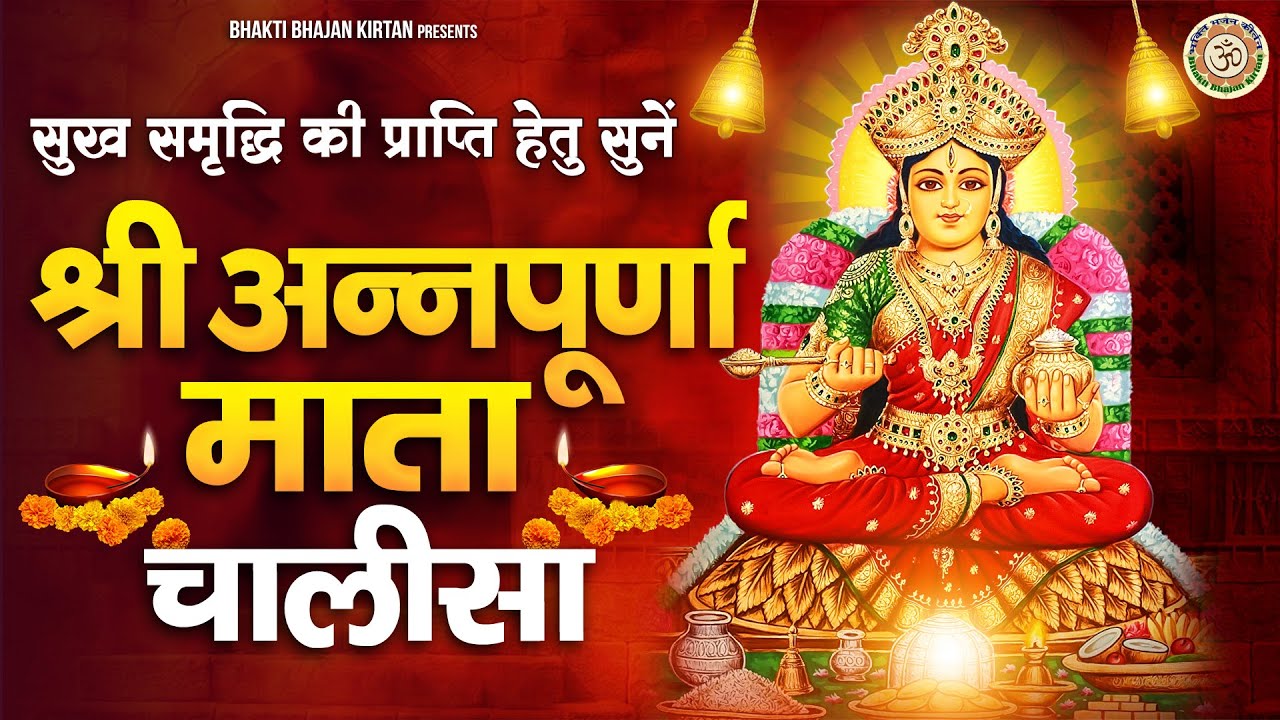
Annapurna herself is the form of Parvati as the goddess of food, abundance, and household sustenance. Iconographically she is depicted four-armed (chaupai 29-30): holding a mala (rosary), a pustak (book), an ankush (goad), and a pasha (noose); riding the bull Nandi (chaupai 5: "Vrishabh-arudh naam Rudrani"); white-bodied and white-clothed (chaupai 3); with the radiance of ten million moons and ten million suns on her face (chaupai 28). Her primary residence is Kashi (Varanasi), where the famous Annapurna temple stands beside the Kashi-Vishwanath jyotirlinga. The classical iconic moment of the Annapurna tradition is Shiva himself – the lord of all – coming to her with his begging bowl to receive bhiksha, establishing that even the supreme Lord depends on the goddess of food.
The Chalisa's narrative arc (chaupais 7-27) is the complete Parvati story compressed into 21 verses: Sati's self-immolation through yog-agni at Daksha's sacrifice (verses 7-8), her rebirth as Girija the daughter of Himalaya (verse 9), Narada's visit and his suggestion of marriage to Brahma, Varuna, Kubera, or Indra (verses 10-12), Parvati's firm vow to marry Shiva alone (verse 13), her tapasya (verses 14-18), Brahma's arrival to grant a boon (verses 19-26), and the union with Shiva (verse 27). Verses 28-40 then turn to the Annapurna form proper – the four-armed iconography, the Annapurne-sadapurne formula, the identification with Mahalakshmi, and the practitioner-facing benefits.
The Chalisa's wider companions are the Parvati Chalisa (Annapurna is Parvati; verse 29 of the Parvati Chalisa names Annapurna directly), the Lakshmi Chalisa (paired for household prosperity), the Shiv Chalisa (Shiva at Kashi receives bhiksha from Annapurna), the Durga Chalisa (the wider Devi form), and the Saraswati Chalisa (the Tridevi triad).
How to recite
A simple, sustainable approach. Nothing here is a hard rule – devotion shapes the form, not the other way around.
-
Preparation
Bathe and wear clean clothes – traditionally white or pale yellow, the colours of Annapurna. Sit in a clean space facing east or facing the kitchen. The traditional offerings are a small bowl of cooked rice (or any cooked food from the morning meal), a small ghee diya, white flowers, fresh fruit, and a piece of jaggery. Some homes also offer a small bhog of khichdi or kheer – the Annapurna-favoured foods. None of this is strictly required for daily recitation.
-
Posture and start
Sit cross-legged on a mat with your spine comfortably straight. Bow once in the direction of the kitchen. Take a moment of silence. If reciting on Akshaya Tritiya, on Annapurna Jayanti, on griha-pravesh day, before opening a new business, or for a specific intention (financial difficulty, food-pressure, family welfare), offer a brief sankalp. Begin with the opening doha (Vishveshvar pad-padam ki...) slowly. Saying it aloud in the kitchen has its own merit.
-
Recitation
Move through the forty chaupais without rushing. Verses 1-7 establish Annapurna's iconography and her identification with Kashi. Verses 7-27 narrate the Parvati biography (Sati's death, rebirth, tapasya, Shiva-marriage). Verses 28-35 describe the Annapurna form proper. Verses 30-31 carry the "Annapurne sadapurne" formula, often slowed down particularly. Verses 36-40 are the practitioner-facing benefit verses. End with the closing doha that names Kashinath as witness.
-
After
Sit quietly with eyes closed for a moment. Many people end with the bija mantra Om Hreem Annapurnayai Namah recited 11 or 21 times. Offer the bhog (a small portion of cooked rice or khichdi) and take a small portion as prasad. Important traditional practice: the first portion of any meal cooked at home is offered as bhog to Annapurna at the kitchen altar before the family eats – this is the daily anna-dan tradition rooted in the Chalisa's closing teaching.
-
Daily practice and special days
One paath a day – morning, before lighting the chulha – is enough for steady daily practice. Tuesdays and Fridays are especially auspicious. Akshaya Tritiya in Vaisakh (April-May) is the major festival. Annapurna Jayanti on Margashirsha Purnima (December) is the second major day. Sharad Navratri (especially Maha Ashtami) is also traditional. For specific intentions – the opening of a new home or kitchen, the start of a food-related business, a family illness involving food/digestion, or any matter of household sustenance – the older practice is 11, 21, 41, or 108 paaths over a fixed period, often paired with a vow to feed eleven brahmins or hold a community bhandara on completion.