On this page
Lyrics with meaning
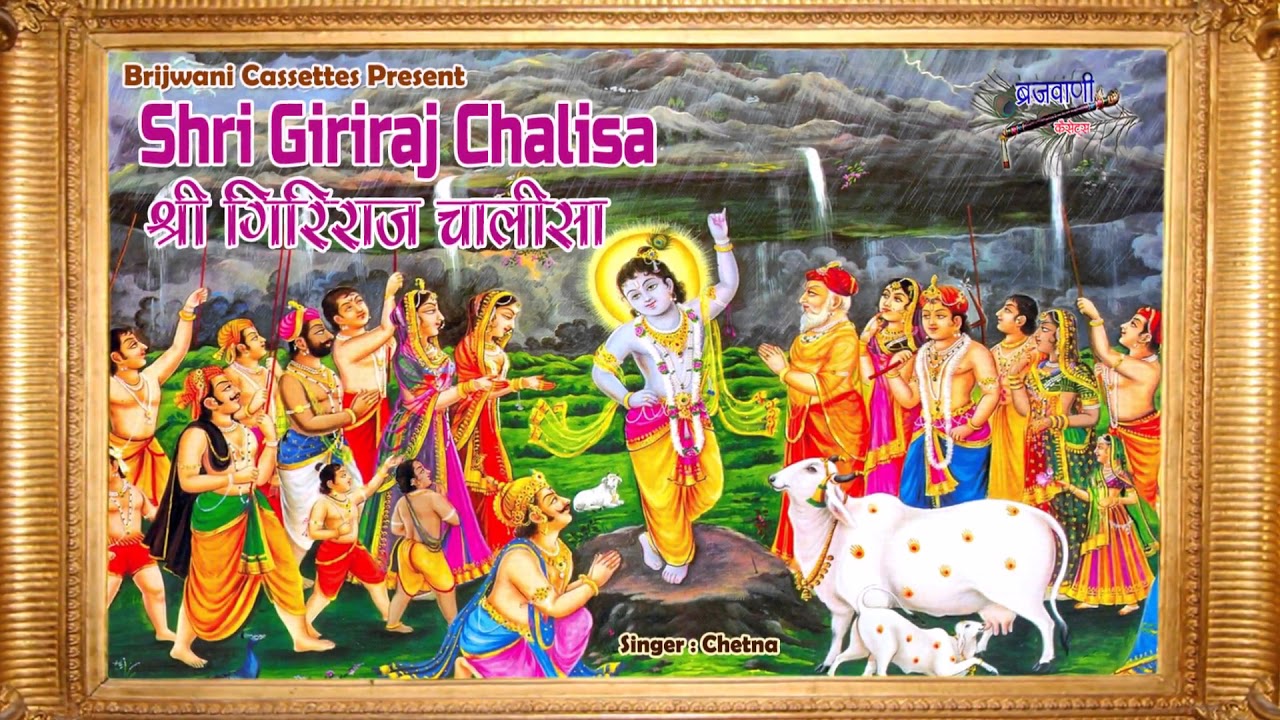
The complete Giriraj Chalisa – two opening dohas, forty chaupais, and a closing doha. A short English meaning sits below every verse. Toggle the script to read in Devanagari, romanized, or both side-by-side.
बन्दहुँ वीणा वादिनी, धरि गणपति को ध्यान। महाशक्ति राधा, सहित कृष्ण करौ कल्याण॥
Bandahun veena vadini, dhari Ganpati ko dhyan. Maha-shakti Radha, sahit Krishna karau kalyan.
I bow to Saraswati the veena-bearer, holding Ganpati in meditation. Mahashakti Radha, with Krishna – please bring complete welfare.
सुमिरन करि सब देवगण, गुरु पितु बारम्बार। बरनौ श्रीगिरिराज यश, निज मति के अनुसार॥
Sumiran kari sab devgan, guru pitu barambar. Baranau Shri Giriraj yash, nij mati ke anusar.
Remembering all the gods, the guru, and the father-figures again and again. I sing the fame of Shri Giriraj according to my own intellect.
जय हो जय बंदित गिरिराजा। ब्रज मण्डल के श्री महाराजा॥
Jai ho jai bandit Giriraja. Braj mandal ke Shri Maharaja.
Hail, hail, the worship-worthy Giriraja. Great king of the Braj region.
विष्णु रूप तुम हो अवतारी। सुन्दरता पै जग बलिहारी॥
Vishnu roop tum ho avtari. Sundarata pai jag balihari.
You are an avatar of Vishnu himself. The world offers itself in sacrifice to your beauty.
स्वर्ण शिखर अति शोभा पावें। सुर मुनि गण दरशन कूं आवें॥
Svarna shikhar ati shobha pavein. Sur muni gan darshan kun aavein.
Your golden peaks shine with great radiance. Gods, sages, and ganas come for darshan.
शांत कन्दरा स्वर्ग समाना। जहाँ तपस्वी धरते ध्याना॥
Shant kandra svarg samana. Jahan tapasvi dharte dhyana.
Your peaceful caves are like heaven. Where ascetics hold their meditation.
द्रोणगिरि के तुम युवराजा। भक्तन के साधौ हौ काजा॥
Drongir ke tum yuv-raja. Bhaktan ke sadhau hau kaja.
You are the prince of Drongir. You accomplish the work of your devotees. (Govardhan was originally part of the Drona mountain in the south, brought by sage Pulastya to Braj.)
मुनि पुलस्तय जी के मन भाये। जोर विनय कर तुम कूँ लाये॥
Muni Pulastya ji ke man bhaye. Jor vinay kar tum kun laye.
You pleased the heart of sage Pulastya. With great prayer, he brought you here.
मुनिवर संघ जब ब्रज में आये। लखि ब्रजभूमि यहाँ ठहराये॥
Munivar sangh jab Braj mein aaye. Lakhi Braj-bhumi yahan thahraye.
When the assembly of munis came to Braj. Beholding the Braj-land, they settled here.
विष्णु धाम गौलोक सुहावन। यमुना गोवर्धन वृन्दावन॥
Vishnu dham Goloka suhavan. Yamuna Govardhan Vrindavan.
The lovely Vishnu-abode of Goloka. Yamuna, Govardhan, Vrindavan – its earthly forms.
देख देव मन में ललचाये। बास करन बहुत रूप बनाये॥
Dekh dev man mein lalchaye. Baas karan bahut roop banaye.
Seeing this, the gods' hearts were tempted. To dwell here, they took many forms.
कोउ बानर कोउ मृग के रूपा। कोउ वृक्ष कोउ लता स्वरूपा॥
Kou banar kou mrig ke rupa. Kou vriksh kou lata svarupa.
Some as monkeys, some as deer. Some as trees, some as creepers.
आनन्द लें गोलोक धाम के। परम उपासक रूप नाम के॥
Anand lein Goloka dham ke. Param upasak roop naam ke.
Taking the joy of the Goloka-dham. As supreme worshippers of the form-and-name.
द्वापर अंत भये अवतारी। कृष्णचन्द्र आनन्द मुरारी॥
Dvapar ant bhaye avtari. Krishnachandra anand Murari.
At the end of Dvapara, the avatar took place. Krishnachandra, the joyful Murari.
महिमा तुम्हरी कृष्ण बखानी। पूजा करिबे की मन ठानी॥
Mahima tumhari Krishna bakhani. Puja karibe ki man thani.
Krishna himself praised your glory. He resolved to perform your puja.
ब्रजवासी सब के लिये बुलाई। गोवर्द्धन पूजा करवाई॥
Brajvasi sab ke liye bulai. Govardhan puja karvai.
He called all the people of Braj. He had Govardhan Puja performed. (Krishna instructed the Brajvasis to worship Govardhan in place of Indra – the founding moment of the festival.)
पूजन केँ व्यञ्जन बनवाये। ब्रजवासी घर घर ते लाये॥
Pujan ke vyanjan banvaye. Brajvasi ghar ghar te laaye.
He had the dishes for puja prepared. The people of Braj brought them from every home.
ग्वाल बाल मिलि पूजा कीनी। सहस भुजा तुमने कर लीनी॥
Gwal baal mili puja kini. Sahas bhuja tumne kar lini.
Cowherd boys together performed the puja. You took on a thousand arms (to receive the offerings).
स्वयं प्रकट हो कृष्ण पूजा में। माँग माँग के भोजन पामें॥
Svayam prakat ho Krishna puja mein. Maang maang ke bhojan pamein.
Krishna himself manifested in the puja. Asking and asking, he received the food. (Krishna himself appeared on Govardhan to receive the offerings, eating in front of the people.)
लखि नर नारि मन हरषामें। जै जै गिरिवर गुण गामें॥
Lakhi nar nari man harshamen. Jai jai Girivar gun gamein.
Seeing this, men and women rejoiced. They sang 'Jai jai Girivar,' celebrating your virtues.
देवराज मन में रिसियाए। नष्ट करन ब्रज मेघ बुलाए॥
Devraj man mein risiyae. Nasht karan Braj megh bulaae.
The lord of the gods (Indra) grew furious. To destroy Braj, he summoned the storm-clouds.
छाँया कर ब्रज लियौ बचाई। एकउ बूंद न नीचे आई॥
Chhanya kar Braj liyau bachai. Ekau boond na niche aai.
Making a shadow, you saved Braj. Not a single drop fell below.
सात दिवस भई बरसा भारी। थके मेघ भारी जल धारी॥
Saat divas bhai barsa bhari. Thake megh bhari jal dhari.
For seven days the heavy rains continued. The clouds, full of water, grew tired.
कृष्णाचन्द्र ने रख पै धारे। नमो नमो ब्रज के पखवारे॥
Krishnachandra ne rakh pai dhare. Namo namo Braj ke pakhware.
Krishnachandra held you on his finger. Salutations, salutations, protector of Braj.
करि अभिमान थके सुरसाई। क्षमा माँग पुनि अस्तुति गाई॥
Kari abhiman thake sursai. Kshama maang puni astuti gai.
Showing his pride, the lord of gods grew tired. Asking forgiveness, he then sang your praise.
त्राहि माम् मैं शरण तिहारी। क्षमा करो प्रभु चूक हमारी॥
Trahi mam main sharan tihari. Kshama karo Prabhu chuk hamari.
'Save me, save me, I am at your feet,' (Indra said). 'Forgive my error, Lord.'
बार बार बिनती अति कीनी। सात कोस परिकम्मा दीनी॥
Baar baar binti ati kini. Saat kos parikamma dini.
Again and again he made his prayer. He performed the seven-kos parikrama. (The 7-kos circuit – about 21 km – which pilgrims still walk to this day.)
संग सुरभि ऐरावत लाये। हाथ जोड़ कर भेंट गहाये॥
Sang Surabhi Airavat laye. Hath jod kar bhent gahaye.
He brought Surabhi (the wish-cow) and Airavat (his elephant). With folded hands, he offered them.
अभय दान पा इन्द्र सिहाये। करि प्रणाम निज लोक सिधाये॥
Abhay daan pa Indra sihaye. Kari pranam nij lok sidhaye.
Receiving the gift of fearlessness, Indra was reassured. Bowing in salutation, he departed for his own realm.
जो यह कथा सुनो चित लावें। अन्त समय सुरपति पद पावैं॥
Jo yah katha suno chit lavein. Ant samay surpati pad pavein.
Whoever hears this story with focused heart. At the last moment, attains the position of the lord of gods.
गोवर्द्धन है नाम तिहारौ। करते भक्तन कौ निस्तारौ॥
Govardhan hai naam tiharau. Karte bhaktan kau nistaraau.
Govardhan is your name. You liberate your devotees.
जो नर तुम्हरे दर्शन पावें। तिनके दुःख दूर है जावे॥
Jo nar tumhare darshan pavein. Tinke dukh door hai jave.
Whoever takes your darshan. Their sorrow goes far away.
कुण्डन में जो करें आचमन। धन्य धन्य वह मानव जीवन॥
Kundan mein jo karein achaman. Dhanya dhanya vah manav jeevan.
Whoever performs achaman in your kunds (sacred ponds). Blessed, blessed is that human life. (The famous Govardhan kunds: Manasi Ganga, Radha Kund, Shyam Kund, Kusum Sarovar.)
मानसी गंगा में जो न्हावें। सीधे स्वर्ग लोक कूँ जावें॥
Manasi Ganga mein jo nhavein. Sidhe svarg lok kun javein.
Whoever bathes in Manasi Ganga. Goes directly to the heavenly realm. (Manasi Ganga – the kund Krishna is said to have created by his thought.)
दूध चढ़ा जो भोग लगावें। आधि व्याधि तेहि पास न आवें॥
Doodh chadha jo bhog lagavein. Aadhi vyadhi tehi paas na avein.
Whoever offers milk as bhog. Mental and physical illness do not come near them. (A verse of devotional faith, not a replacement for medical care.)
जल फल तुलसी पत्र पढ़ावें। मन वांछित फल निश्चय पावें॥
Jal phal tulsi patra padhavein. Man vanchhit phal nishchay pavein.
Whoever offers water, fruit, and a tulsi leaf. Surely receives the heart's desired fruit.
जो नर देत दूध की धारा। भरौ रहे ताकौ भण्डारा॥
Jo nar det doodh ki dhara. Bharau rahe takau bhandara.
Whoever offers a stream of milk. Their treasury remains full.
करें जागरण जो नर कोई। दुख दरिद्र भय ताहि न होई॥
Karein jagran jo nar koi. Dukh daridra bhay tahi na hoi.
Whoever holds a night-vigil for you. Sorrow, poverty, and fear do not befall them.
श्याम शिलामय निज जन त्राता। भक्ति मुक्ति सरबस के दाता॥
Shyam shila-may nij jan trata. Bhakti mukti sar-bas ke data.
Stone-form of Shyam, saviour of your devotees. Giver of devotion, liberation, and all-things. (The black shaligram-Govardhan-shilas – self-existent stones from the mountain – kept as primary household deities in Pushti Marg homes.)
पुत्र हीन जो तुम कूँ ध्यावें। कूँ पुत्र प्राप्ति ह्वै जावें॥
Putra-hin jo tum kun dhyavein. Kun putra prapti hvai javein.
The childless who meditate on you. Receive the boon of a child. (A verse of devotional faith, not a replacement for medical care.)
दंडौती परिकम्मा करहीं। ते सहजहि भवसागर तरहीं॥
Dandauti parikamma karahin. Te sahajahi bhav-sagar tarahin.
Whoever performs the dandavat parikrama (full prostration around the mountain). They easily cross the worldly ocean. (The most rigorous form of the 7-kos parikrama – with full prostration at every step, taking weeks.)
कलि में तुम सम देव न दूजा। सुर नर मुनि सब करते पूजा॥
Kali mein tum sam dev na duja. Sur nar muni sab karte puja.
In Kali Yuga, there is no other deity equal to you. Gods, men, and munis all worship you.
जो यह चालीसा पढे, सुनै शुद्ध चित्त लाय। सत्य सत्य यह सत्य है, गिरिवर करें सहाय॥
Jo yah Chalisa padhe, sunai shuddh chit laay. Satya satya yah satya hai, Girivar karein sahay.
Whoever reads this Chalisa, or hears it with pure heart. Truth, truth, this is the truth – Girivar gives them help.
क्षमा करहुँ अपराध मम, त्राहि माम् गिरिराज। श्याम बिहारी शरण में, गोवर्द्धन महाराज॥
Kshama karahun aparadh mam, trahi mam Giriraj. Shyam Bihari sharan mein, Govardhan Maharaja.
Forgive my faults, save me, Giriraj. In the shelter of Shyam Bihari, Govardhan Maharaja.
Why this chalisa
What the Giriraj Chalisa is recited for, and what people turn to it for.
Centrepiece of Govardhan Puja and Annakut
Govardhan Puja on Kartik Shukla Pratipada (the day after Diwali), also called Annakut, is the year's major Giriraj day. Verse 14 of the Chalisa narrates the founding moment: Krishna instructed the Brajvasis to worship Govardhan instead of Indra. On this day, households across north India build a small Govardhan-shape from cow-dung, decorate it with flowers, and offer the Chappan-bhog – fifty-six varieties of food (the 'mountain of food') – to Krishna and Govardhan.
Anchor for the 7-kos Govardhan parikrama
Verse 25 of the Chalisa names the most sacred Vrindavan-area pilgrimage: the seven-kos parikrama (about 21 km) around Govardhan. Many pilgrims walk it barefoot; some do dandavat parikrama (full prostration at every step), which takes weeks. Verse 39 names this directly. The parikrama covers Manasi Ganga, Radha Kund, Shyam Kund, Kusum Sarovar, Daan Ghati, Mukharvind, Punchhri ka Lautha – each named in verse 31's kunds reference.
Anchor for Pushti Marg seva
Govardhan is held in the Pushti Marg sampradaya as the very form of Krishna himself – the famous Shrinathji at Nathdwara is the form of Govardhan-Krishna lifted on the finger. Many Pushti Marg homes keep a small Govardhan-shila (a stone from the mountain) as their primary household deity. Verse 37 names this directly: "Shyam shila-may nij jan trata". The Chalisa is recited daily at the morning seva.
For boons – fertility, financial well-being, illness recovery
Verses 33-38 carry the practitioner-facing benefits: milk offerings keep illness away (verse 33), tulsi-leaf offerings grant the heart's desired fruit (verse 34), milk-stream offerings keep the treasury full (verse 35), the night-vigil keeps poverty away (verse 36), the childless attain children (verse 38). Many devotees keep the Chalisa as a daily anchor through any household difficulty. (These are verses of devotional faith, not replacements for medical or professional advice.)
Companion to Krishna and Yamuna worship
Govardhan is inseparable from the Krishna-Vrindavan tradition. Pair with the Krishna Chalisa and the Yamuna Chalisa for the complete Vraj-trio. The Radha Chalisa completes the parikrama-tradition (Radha Kund is one of the major stops on the 7-kos circuit).
For Annakut and the Chappan-bhog tradition
The Chappan-bhog – fifty-six varieties of food offered as Annakut – is rooted directly in verse 16 of the Chalisa: "sahas bhuja tumne kar lini" ('you took on a thousand arms') and verse 17: "maang maang ke bhojan pamein" ('asking and asking, you received the food'). Many large temples – Nathdwara, Banke Bihari at Vrindavan, ISKCON Vrindavan – arrange the full Chappan-bhog on Govardhan Puja day. Many home altars do a representative seven-bhog version.
Origin
The Giriraj Chalisa carries no clear signature line. The text is generally placed in the 18th-19th century CE by language and content, written in Hindi with strong Brajbhasha influence – the language of Vrindavan and the Pushti Marg tradition. The opening doha invokes Maha-shakti Radha sahit Krishna – placing the Chalisa firmly in the Radha-Krishna parampara of the Pushti Marg founded by Vallabhacharya.
Govardhan himself has a distinctive identity – he is a mountain treated as a deity, the form of Krishna and the central object of Pushti Marg worship. The legend (preserved in the Bhagavata Purana, 10th canto): the people of Braj traditionally performed an annual puja for Indra to receive the rains. Krishna, when about seven years old, instructed them to instead worship Govardhan – the mountain that actually gave them the grass for cattle, the water from its springs, the fruits and herbs. Indra, furious, sent torrential rain (the Pralaya-megha) to destroy Braj. Krishna then lifted Govardhan on the little finger of his left hand and held it as a parasol for seven days and nights, sheltering all the people and cattle. Indra eventually surrendered, performed the seven-kos parikrama in apology, brought Surabhi the wish-cow and Airavat his elephant as offerings, and acknowledged Krishna as the supreme Lord. The Chalisa's verses 14-27 narrate this story in compressed form.
Govardhan's pre-Krishna origin is also given in the Chalisa (verses 5-7): the mountain was originally part of Drongir in the south, brought by the sage Pulastya to Braj after his great tapasya. The mountain itself is now about 8 km long, with peaks of varying heights, located in Mathura district, Uttar Pradesh. The 7-kos parikrama starts at Manasi Ganga and covers Daan Ghati, Mukharvind, Radha Kund, Shyam Kund, Kusum Sarovar, Punchhri ka Lautha, and returns. Many Pushti Marg homes keep a small Govardhan-shila as their primary household deity, treated exactly as a Shaligram or a Krishna-murti.
The Chalisa's wider companions are the Krishna Chalisa (Govardhan is Krishna), the Radha Chalisa (Krishna's consort), the Yamuna Chalisa (the river Govardhan touches), and the Vishnu Chalisa (verse 2 names Govardhan as Vishnu's avatar).
How to recite
A simple, sustainable approach. Nothing here is a hard rule – devotion shapes the form, not the other way around.
-
Preparation
Bathe and wear clean clothes. Sit facing east or in the direction of Govardhan (north-west of most of India). The traditional offerings: milk (the most-loved Govardhan offering), tulsi leaves, butter (Krishna's favourite), white or red flowers, akshat, fruits, and a single ghee diya. For Govardhan Puja day specifically, build a small mound from wet cow-dung shaped like a cresent (the Govardhan-form), decorate with flowers, and offer the bhog at its base.
-
Posture and start
Sit cross-legged with your spine straight. Bow once. Take a moment of silence. If reciting on Govardhan Puja, before the 7-kos parikrama, on Annakut, or for a specific intention, offer a brief sankalp.
-
Recitation
Move through the forty chaupais without rushing. Verses 1-12 establish Govardhan's identity. Verses 13-22 narrate the Krishna-Govardhan-Indra story. Verses 25-29 describe Indra's parikrama (the 7-kos tradition). Verses 30-39 are the practitioner-facing benefits. End with the two closing dohas.
-
After
Sit quietly with eyes closed. Many people end with the bija mantra Om Govardhanaya Namah recited 11, 21, or 108 times. Offer the milk and butter bhog at the Govardhan-shila if available.
-
Daily practice and special days
Govardhan Puja on Kartik Shukla Pratipada (the day after Diwali) is the year's major day. Annakut is the same day in many traditions. Krishna Janmashtami eve is also recited at major Govardhan temples. Pushti Marg homes recite daily before the morning seva. The 7-kos parikrama itself is undertaken at any time – traditionally during Kartik month or the Govardhan-Vrindavan parikrama season.